On Monday, August 17th the Ministry of Education held its annual education review at the Resource Room of the Albena Lake-Hodge Comprehensive School. Education leaders of all public schools on the island came together to be informed of new strategies of educating, to chart the way forward for the upcoming school year, as well as to share in discussions on the new Education Development Plan for the period 2025 to 2030.
The opening ceremony of the Review was attended by Her Excellency the Governor Julia Crouch; the Honourable Minister of Education, Mrs. Shellya Rogers-Webster; and the Honourable Minister of Tourism Health and Sports, Mr. Cardigan Connor. Principal Assistant Secretary for Social Development & Education, Ms. Jocelyn Johnson; Education Services Planer, Mrs. Dawn P. Reid; as well as Acting Chief Education Officer, Ms. Deavene Guishard, were also present. The moderator was the Permanent Secretary in the Ministry of Education, Dr. Bonnie Richardson-Lake.
In her welcome remarks, Dr. Richardson-Lake shed light on the new strategic Education Plan under the theme “Education Re-imagined”. “Today marks the beginning of the next phase of a collective commitment to strengthen education in Anguilla,” she said. “The Education Development Plan is the sixth strategic plan for the education sector and builds on the work of previous plans, while deliberately looking ahead to the changing needs of our learners, our educators, our economy and our society.
“The theme that runs through the Plan is ‘Education Re-imagined’. That is an appropriate description of the task before us. Education is operating in an environment shaped by rapid technological change, the lessons of Hurricane Irma and the COVID-19 pandemic, evolving workforce needs and increasingly diverse learner needs. Our response cannot simply be to preserve what has always been done. We must retain what works, address what does not, and be prepared to innovate.
“The Plan therefore places the learner at the centre and identifies four clear priorities for the period to 2030: 1. strengthening teacher quality; 2. prioritizing student engagement; 3. enhancing the school-parent relationship; and 4. ensuring the development and effective allocation of the resources needed to deliver quality education.”
“These priorities recognize that good outcomes for students depend on much more than what happens during a lesson,” she said. “They depend on capable and supported educators, engaged students, strong families and school partnerships, effective leadership, appropriate facilities and resources, and systems that allow us to monitor results and improve continuously.”
Mrs. Rogers-Webster, at the beginning of her address, mentioned that she had refrained from preparing a scripted speech, but rather felt moved to speak to the educator leads from her heart. She therefore challenged the teachers to look within and evaluate their own outlook with regard to the tasks of effective educating.
“As we move forward into the new school year, I would ask you to do some self-reflection, for it is easy for us as humans to point to the things that are not going well. We tend to identify what those below us and those above us are doing, what they are not doing, or what they need to do better. But as I have looked at the last school year, I have been moved to say that we need to do some self-reflection.”
She insisted that the success of education is largely dependent on the quality of the individual teachers, and if education is to thrive and be a successful venture, then the key leaders in education must be the drivers of that success.
“So I am asking us as leaders in education to self-reflect,” she encouraged. “We often ask our teachers to get to school on time and be properly prepared. But are we as leaders in education setting that example? And we ask our students to be on time and to do their work effectively, but are we as education leaders doing likewise?
“As education leaders, the success of this Education Review and this Education Development Plan is largely going to be dependent on our ability to effectively perform in our roles. So let us self-reflect,” she reiterated.
Education Services Planner, Mrs. Dawn P. Reid, highlighted, in particular, the part that each individual education leader plays towards contributing to collective tasks in education as a whole.
“Today, the Education Review and the launch of the new Education Plan are primarily about a collective effort,” she said. “It is about all education stakeholders contributing to and agreeing on the direction and path for the development of Anguilla’s education sector. This Review is about the future of Anguilla’s young people and the development of human capital in keeping with Anguilla’s developmental needs.”
“Each of us has contributed in some way or another towards the development of the Strategic Plan for the period 2025 to 2030. Whether it was by pointing out where the challenges and issues lie within the education sector, or contributing solutions toward mitigating these problems, or whether it was through day-to-day interaction, or during focus group discussions particularly for this purpose. But, collectively it is all about having shared commitments,” Mrs. Reid emphasized.
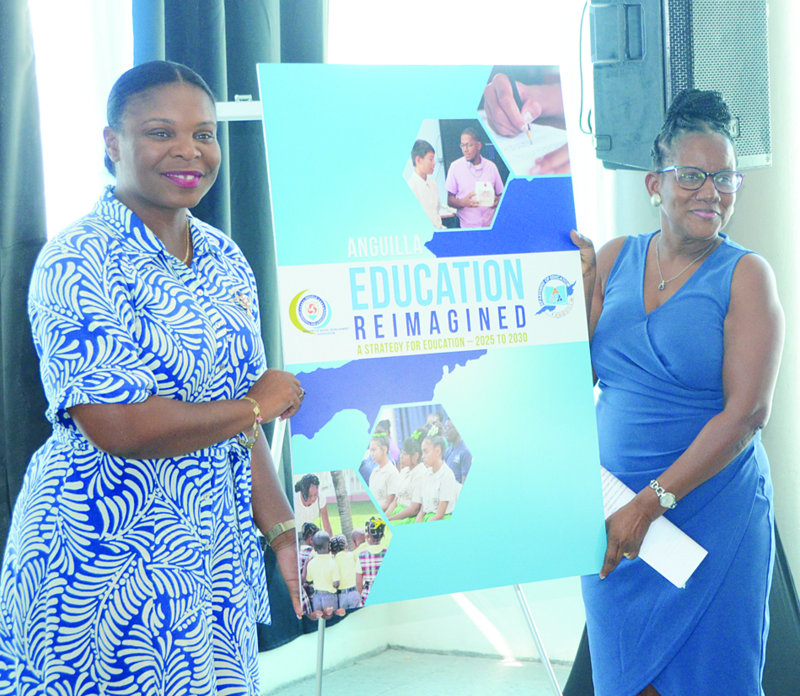
Following Mrs. Reid’s address, she and the Minister unveiled the banner depicting the Strategy for Education – 2025 to 2030, bearing the theme “Education Re-imagined”. According to Mrs. Reid, this Education Development Plan (EDP) is the sixth such Plan for the Education Sector administered by the Government of Anguilla. It provides a strategic roadmap for the education sector over the next five years and builds on the gains of previous strategic plans for education.
By: James R. Harrigan