Chapter V of the 1982 Anguilla Constitution Order addressed not only making laws, but also for a Governor to “return” bills with “any amendment which he may recommend” in Section 58. Whereas further sections defined additional House of Assembly members’ duties. [1]

Return of Bills by Governor
The Governor’s power to assent or “reserve” any bill he deems “repugnant or inconsistent” with the Constitution – or ascribing “privileges, immunities or powers of the Assembly or of its members” (unless authorised by the Secretary of State) are expanded in Section 58: “The Governor may return to the Assembly any Bill presented to him for assent, transmitting therewith any amendment which he may recommend, and the Assembly shall deal with such recommendation.”[1] “Shall”? – not “may”?
 Earlier sections repeatedly undermined “freedoms” as subject to “any law” in the future. However, later sections conferring Governors’ powers rarely mentioned future laws – or like Section 56, asserted supremacy: “notwithstanding any provision of this Constitution or of any other law… or of any rules of procedure of the Assembly”; such powers are subject to revocation only by the Secretary of State.[1] Here, elected representatives “shall deal” with the Governor’s wishes, period. Why the farce after Section 56 said the Governor can enact any bill after just one reading – without a single vote?
Disallowance of laws
Section 59 states: “Any law to which the Governor has given his assent may be disallowed by Her Majesty through a Secretary of State…[and] Whenever a law has been disallowed… the Governor shall, as soon as practicable, cause notice of the disallowance to be published in the Official Gazette and the law shall be annulled with effect from the date of the publication…”[1]
Notably, such references to Secretary of State powers provided a glimmer of hope to the Concerned Citizens when they sought disallowance of the Goods and Services Tax Act of 2021.[2] It was not only inconsistent with illusory Constitutional freedoms in the early sections of the Order, but it reversed a pivotal election promise, was culturally intrusive and fiscally unnecessary for a shortfall of $22Million EC with the borders closed during the pandemic. And, after the last administration shattered spending records, we see that so many have suffered so much for a GST ‘gap’ that is now a rounding error.
These factors were compounded by the People being lectured, not listened to, in public consultations. As well as the repeated dismissal of petitions and the Deputy Governor and the Attorney General failing to recuse themselves on such a fraught bill, especially after the AG advised the Speaker right before his vote. To name a few reasons they expected the Secretary of State to disallow that law.[2]
Section 59 also cited prior law instead of future bills: “The provisions of section16(1) of the Interpretation Act 1978, shall apply to the annulment of any law under this section as they apply to the repeal of an Act of Parliament, save that any enactment repealed or amended by or in pursuance of that law shall have effect as from the date of the annulment as if that law had not been made.”[1] Ah, if only that could have been the case following that fateful night in July 2021.
Oath of allegiance
Section 60 required a commitment to the monarch, but not the People: “Except for the purpose of enabling this section to be complied with, no ex-officio, nominated or elected member of the Assembly shall be permitted to take part in its proceedings until he has made before the Speaker an oath of allegiance in the form set out in the Schedule to the Constitution.”[1,3]
Privileges of Assembly and members
Section 61 is puzzling, because it suggests powers to regulate the Assembly by Ministers’ votes: “A law enacted under this Constitution may determine and regulate the privileges, immunities and powers of the Assembly and its members, but no such privileges, immunities or powers shall exceed those of the Commons’ House of Parliament of the United Kingdom or of the members thereof.” However, Section 56 required the Governor’s Assembly oversight, authorised by the Secretary of State. [1]
Sessions
Sections 62 and 63 required just one meeting per year, saying, “Subject to the provisions of this Constitution, the sessions of the Assembly shall be held at such places and begin at such times as the Governor may from time to time by Proclamation appoint…[and] There shall be at least one session of the Assembly in every year, so however that there shall be an interval of less than twelve months between the last sitting in one session and the first sitting in the next session.”[1] Why should they meet at all, unless ours will be the fourth BOT constitution to limit Governors’ powers?
Prorogation and dissolution
And, Sections 64 to 66 provide for at least one election every 5 years, as well as snap elections: “The Governor, acting… with the advice of the [Premier], may at anytime, by Proclamation… prorogue the Assembly…[and] may at any time… dissolve the Assembly…[and] The Governor shall dissolve the Assembly at the expiration of five years from the date when the Assembly first meets after any general election unless it has been sooner dissolved.”[1,4]
General elections
Section 67 further required: “There shall be a general election at such time within two months after every dissolution of the Assembly as the Governor shall by Proclamation appoint.”[1] As such, elections could theoretically take place multiple times per year but in no case fewer than once every five. Hmm.
The Constitution, Disallowing Laws – and the General Services Tax (GST)…
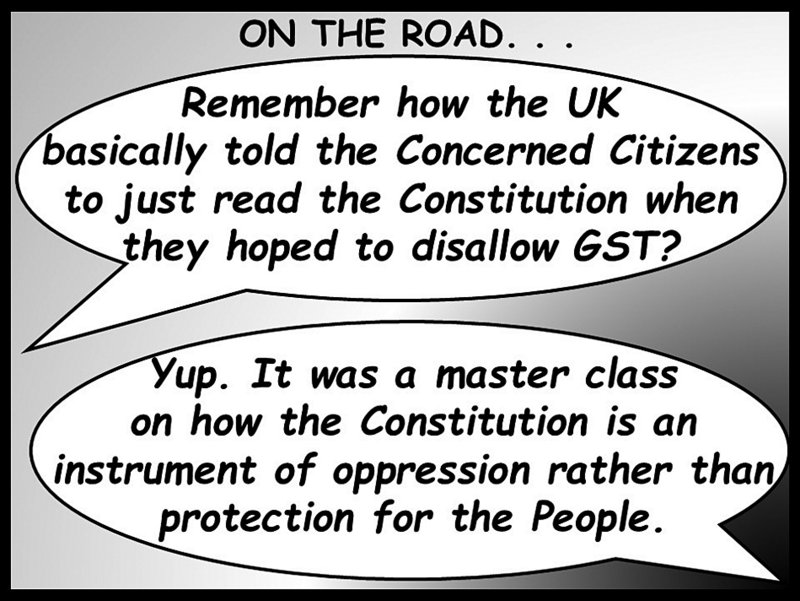
Remember hoping the Secretary of State would disallow a law that effectively nullified an election? It was a master class in why this Constitutional review and every new law must be taken so seriously.
The UK response was firstly delegated to an underling, “…I have been asked to reply on their behalf.” He then asserted, “The GST Bill passed by the House of Assembly on 29 July 2021 was in compliance with Anguilla’s constitutional provisions…” despite “…significant debate…” And, “Under the Constitution, the Attorney General and Deputy Governor are [House] members… with the ability to make it quorate by their presence and can move and vote on legislation….[and that] The Governor must act in accordance with the Constitution, and she gave assent in accordance with its terms.” As if we couldn’t read? He concluded, “The United Kingdom does not plan to take any steps to disallow this Act.” [5]
Then, public servants serving the Crown curated and replaced that law driven by another election promise. It continues to threaten warrantless searches, forced oaths, self-incrimination, and countless costs, fees, fines and imprisonment as if never repealed.[6] Meanwhile, AI revenues are hoarded for pay raises and projects, private matters are vulnerable to capricious audits of lawyers and accountants, and parents struggling to educate children must pay ANGLEC, phone and Internet bills inflated for a bloated government while subsidising offsets to those who need them the least.
So, how much longer will the General Services Tax Act remain a mockery of rights so many thought were in the Constitution, especially now that AI revenue can replace it? …An Order amended by any such repugnant, constitutionally inconsistent law at any time, with powers for a Governor to enact them with “any amendment which he may recommend” – without any votes at all?
Repeal General Services Tax – and pass a balanced budget bill. Now.
This article reflects issues raised on July 5, 2021, at the House Select Committee on GST Public Hearing.
[1] Anguilla Constitution Order 1982; [2] https://theanguillian.com/2021/09/concerned-citizens-awaiting-reply-from-uk-officials-on-gst/; [3] Anguilla Constitution Order 1982 S.I. 1982 No. 334; [4] Anguilla Constitution (Amendment) Order 2019; [5] FCDO Letter, 18 October 2021; [6] General Services Tax Act, 2025.