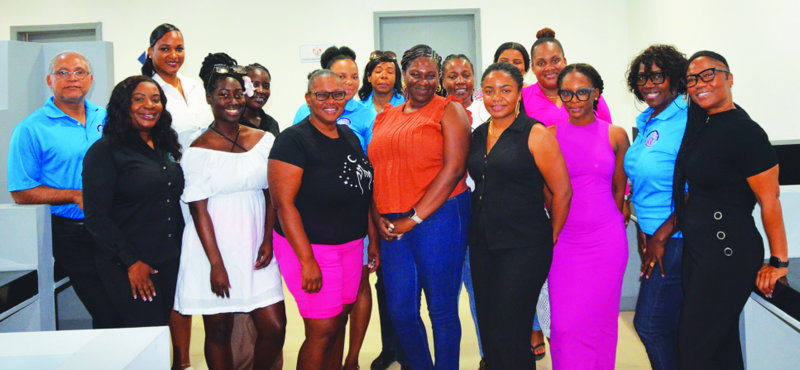
Tuesday, March 17th was internationally designated as Social Workers Day 2026, and that morning a team of social workers met in the conference room of Innovative Anguilla to engage in a special developmental session facilitated by Anguilla’s Chief Nursing Officer, Mrs. Twyla Bradshaw-Richardson.
The topic of the lecture was “Wellness in Navigating Challenges in an AI generation”, and its aim was to sensitize the participants to the need for advancing themselves in their various professions by adapting to transformative mindsets that would serve to make their careers as social workers more efficient and effective.

Mrs. Bradshaw-Richardson highlighted the fact that the demands of social workers’ tasks can cause them to become overwhelmed at times, especially when everything around them is moving so fast and the potential is there to be confused.
She made reference to the recent era of the COVID-19 pandemic when conditions were changing spasmodically, yet, healthcare workers and medical officials were required by protocol to demonstrate a sense of stability to facilitate standard operating procedures.
“So How do we navigate or maintain our wellness when everything around us is moving fast and information is changing? The question is how do we maintain stability, whether in our personal lives or in our professional lives?” she asked.
Asking some select participants what strategies they would use to maintain stability during challenges, Mrs. Bradshaw-Richardson received a range of answers as coping antidotes. However, she stressed that there is no one pathway to a solution that would create stability in challenging situations.
“Remember that for every area of strength you may have, for every coping mechanism you might possess, there is a counter force that can disrupt your stability. In other words, there is no one area of strength to ‘fix it all’ when conditions around you are changing in swift succession. So, you must be able to adapt with the shifting settings, because things change, and things change fast,” she said.
She affirmed to the social workers that one major element which would carry them through the challenges is “Self Awareness”. “Self Awareness is understanding what your strengths are; what your weaknesses are; what your triggers are; and what propels you,” she said. Mrs. Bradshaw-Richardson advised the participants that if they should ever become vulnerable to some hindering weakness or weaknesses, then they will need to rely on the people that are around them.
She expressed that while one should always demonstrate self awareness and recognize his or her strengths, it is important for workers not to boast about their strengths, for doing so may cause others around them or their colleagues to shy away from them and avoid them, thus leaving them with little support.
“Further, you must learn how to use the tools that boosts your strengths and support your weaknesses,” she noted. “You can do so by asking others what they think about you, considering your performance in challenging situations. With such feedback you might be better able to navigate,” she said, “or, there is an assessment tool called Clefton Assessment which can be used to measure your capabilities in performance during such challenging times.” She mentioned that such tools can make the social workers more efficient, knowing their personality type.
She also recommended that the social workers learn to use AI tools that would help to make their work easier and mitigate some of the challenges that they might face. “I am not just speaking about ChatGPT,” she said. “There is a very efficient AI tool called Hazel which you should learn to master, for it is quite efficient in helping you to compile your reports and documents for presentation.”
“In order for your behavior to change,” she said, “first you will need to acknowledge that change must take place. You must realize that there is something better. No one knows it all. And no matter how good or how strong you might think you are, somebody knows something better than you. And the beautiful thing about reaching you highest level of self- actualization is to improve on your areas of weakness.”
She next focussed on “A Continuous Line”. This implies that people who realize that they need to change and continue working towards that change will benefit the most. But if a person who needs to change puts up a barrier, acting carelessly about making any effort to change, that person would experience little or no progress. The key factor here, therefore, would be to remain consistent, and not to be deterred or swayed by other’s negative views or by a lack of motivation.
In general, the social workers were satisfied with the benefits they derived from Mrs. Bradshaw-Richardson’s motivational lecture. They all regarded it as a rewarding session, and they appreciated what they deemed to be very timely advice for themselves in the realm of social work.
By: James R. Harrigan