Artificial intelligence (AI), digital government and climate resilience are no longer topics reserved for international conferences — they are rapidly becoming part of the conversation about how Caribbean governments, including Anguilla’s, will deliver public services in the years ahead.
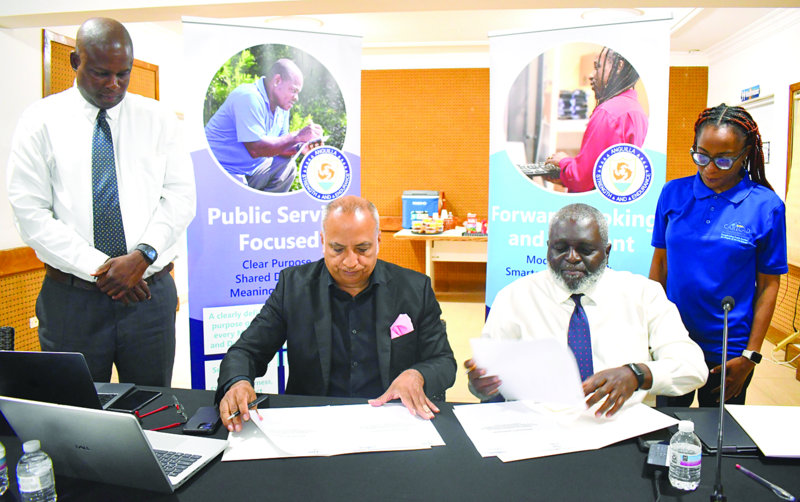
Those issues were prioritised on Friday, 10th July 2026, when the Caribbean Centre for Development Administration (CARICAD) and the Latin American Centre for Development Administration (CLAD) formally signed a new Memorandum of Understanding (MOU), strengthening a long-standing partnership during a CARICAD Board meeting in Anguilla.
Although the agreement marks a new chapter, CARICAD Director General Devon Rowe made it clear that the relationship is far from new.

 “This is not our first MOU,” he said, recalling that an earlier agreement between the organisations produced the Caribbean Charter for Public Services with support from Spain. Even after that agreement expired, he explained, the partnership never really stopped. Instead, the new MOU provides a clearer framework for tackling the issues Caribbean governments are facing today.
Among the priorities are AI and open government, digital government transformation, climate change, ethics in public life, human resource management and youth development. Rowe noted that many of those same topics had already featured prominently during CARICAD’s Board discussions the previous day, reflecting the priorities of member governments rather than simply those of the two organisations.
Importantly, he said, Member States themselves will help shape annual work plans over the five-year agreement, ensuring that projects respond to the needs of the region.
The Hon. Deputy Governor Perin Bradley welcomed Board members and later witnessed the signing after the agreement received unanimous approval from the CARICAD Board.
CLAD Secretary-General Dr. Alexander López described the agreement as another step in broadening the Caribbean’s links with an international network that now spans 24 member states across Latin America, Europe and Africa. Beyond providing technical assistance and research, CLAD hosts major forums where governments exchange ideas on improving public administration.
That collaboration is already producing results. At the end of September 2026, CARICAD, CLAD and the United Nations will jointly host a Regional Forum on Governance Innovation in Santo Domingo, Dominican Republic, bringing together experts from around the world to explore new approaches to public sector innovation across the Caribbean.
The organisations are also collaborating on a new publication, The Future of the Caribbean, which will examine how the region could evolve by 2050. CARICAD is leading the chapter on the future of the Caribbean public sector, alongside contributions examining economic development, sustainability and regional integration.
Dr López also pointed to growing international interest in the Caribbean, highlighting Brazil’s renewed engagement with the region under President Luiz Inácio Lula da Silva, as well as discussions with the Organisation for Economic Co-operation and Development (OECD) about expanding its work in the Caribbean.
While the discussions focused on regional cooperation, many of the issues raised have direct relevance for Anguilla. As governments increasingly embrace digital services and emerging technologies such as AI, partnerships like this are expected to help public sectors modernise, improve efficiency and respond more effectively to the needs of citizens.
While the agreement was signed between two regional organisations, its real success will ultimately be measured far from the boardroom. Whether through faster government services, stronger public institutions or better preparation for emerging challenges, the partnership is intended to help Caribbean governments, including Anguilla’s, deliver more effectively for the people they serve.
By Janissa Fleming