The word “reserves” appears twice in the Anguilla Constitution Order of 1982. In Section 9, “Her Majesty ‘reserves’ to Herself power, with the advice of Her Privy Council, to make laws for the peace, order and good government of Anguilla”; and it described a Governor’s refusal to assent to a law.
That is, in Section 57, “…he ‘reserves’ the Bill for the signification of Her Majesty’s pleasure…any Bill which appears to him to be in any way repugnant to, or inconsistent with, the provisions of this Constitution…”[1] Repugnant? Inconsistent? The Goods and Services and the General Services Tax acts were repugnant – and inconsistent with expected rights – but “for the purpose of any tax”![1]
 “Reserves” in Anguilla…
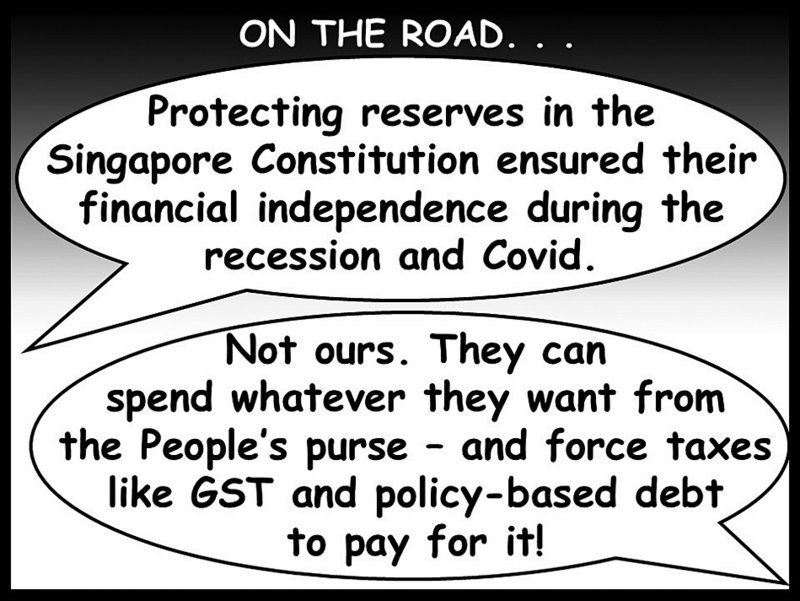
So, “reserves” refers to wielding power in our Constitution. The word “budget” doesn’t appear at all! By default, it is therefore constitutional in Anguilla to tax the People, take reserves and borrow for anything any government wants to spend without safeguards for the People, or any future generations. Notably, a deficit of EC$73M is anticipated this year, and it may be financed from “reserves” here in Anguilla, at the discretion of the Government for whatever they choose to spend.[2]
“Reserves” in Singapore…
In the Singapore Constitution, “reserves” appears 86 times, and “budget” 59 times.[3] Laws matter. In fact, creating constitutional guardrails to protect the wealth of its People and future generations has helped Singapore achieve financial independence as a tiny island nation. They built a sovereign wealth fund second only to China’s and the UAE, respectively with the second largest population and some of the largest oil reserves in the world.
The Singapore fund is comprised of specific entities, including: the Monetary Authority of Singapore, the Government of Singapore Investment Corporation, Temasek Holdings, and the Central Provident Fund.[4] Imagine. Financial reserves ranked 3rd for a city-state of ~6 million ranked 115th in population and 177th of 197 countries in size, with 277.6 square miles, including inland water![5,6]
Presidential Safeguards…
And accountability is clear. Section 17 states, “There shall be a President of Singapore who shall be the Head of State. … it is also the function of the President to safeguard the reserves of Singapore and the integrity of the Public Services… and…perform this function according to… this Constitution…”[3]
Their President must also guard against contingent liabilities through leadership oversight, whereby “…no appointment to the office of chairman, member or chief executive officer of any statutory board …shall be made by any appointing authority unless the President, acting in his discretion, concurs therewith.” [3] Our Premier is lucky to be “consulted” on such matters in our Constitution.
And, once the boards have been appointed and approved, “The President, acting in his discretion, may refuse to approve any budget or supplementary budget of any such statutory board if, in his opinion, the budget is likely to draw on reserves which were not accumulated by the statutory board during the current term of office of the Government, except that if he approves any such budget notwithstanding his opinion that the budget is likely to so draw on those reserves, the President shall cause his opinion to be published in the Gazette.” [3] What can our Premier do if a statutory body overspends?
Past Reserves: Accumulated Before the Current Term of Office
For routine Government budgets, like our Appropriation Bills, they must prepare and pass a “Supply Bill, providing for the issue from the Consolidated Fund and Development Fund of the sums necessary to meet that expenditure and the appropriation of those sums for the purposes specified therein.” Budget overruns or new expenditures are likewise addressed as in Anguilla. As such, “supplementary estimates” [or a Supplementary Supply Bill] shall be prepared by the Minister responsible for finance and, when approved by the Cabinet, shall be presented to and voted on by Parliament” [3] – so fiscal discipline is enshrined in their Constitution. Ours has no mention of it.
The law also requires that “a Final Supply Bill containing any such sums which have not yet been included in any Supply Bill” be prepared as soon as practicable after the end of a fiscal year. But. “The Minister responsible for finance shall, in presenting to Parliament any supplementary estimates or statement of excess under clause (2), also present a statement stating whether the supplementary estimates or statement of excess, as the case may be, is likely to draw on the reserves which were not accumulated by the Government during its current term of office.” [3] Past reserves are thus sacred in Singapore.
Transactions, Transparency – and Balanced Budgets
Section 148 further protects the reserves from specific transactions: “It shall be the duty of the Auditor-General and the Accountant-General to inform the President of any proposed transaction by the Government which to their knowledge is likely to draw on the reserves of the Government which were not accumulated by the Government during its current term of office.” [3]
Their Constitution also requires that the President be given any information he requests from any Government ministry, company or statutory board. As with budgets, he must be informed for oversight of transactions – and to inform the Prime Minister and the People by Gazette if he approves spending beyond his term. Likewise, Government companies or boards must use resolutions and Ministerial oversight to account for any transfers between them based on when they were accumulated.[3]
So why all that attention to whether spending exceeds funds accumulated in the current term? Their constitutional framework helps ensure balanced budgets by spending no more than they generate. By protecting reserves, they have protected their People from the humiliation of conditional aid and policy-based loans during the Great Recession, pandemic and more. [7] You know. Like “grants” after Irma?
Forbidden Fiscal Fruit Guarded for Future Generations
Indeed, in Section 142, they specifically safeguard reserves by forbidding access to ”50% of the net investment income of the financial year that is derived from the past reserves of the Government… [which] shall accrete and be deemed to form part of the past reserves of the Government…”[3]
Other fiscal powers and procedures given the supremacy of constitutional clauses also include the management of Contingencies Funds, Parliamentary oversight, Supply (budget) bills, and loan guarantees, further reflecting the discipline that has secured Singapore’s financial independence.
…and the General Services Tax (GST)
Instead, our Constitution has allowed future laws to poison our People. From pernicious powers retained in the General Services Tax Act,[8] which allowed this government to keep its election promise and nothing more, too many keys remain in the locks but for “any law” and “satisfaction of any tax” in our Constitution. Such exceptions have legalised whatever degree of capricious enforcement this or any future Comptroller wishes to inflict to take and spend as much as they please.[1]
So. That law hangs over our People and businesses like a venomous snake dangling from a tree. Now, imagine if our Constitution demanded that our leaders “safeguard the reserves” of Anguilla. An annualised shortfall, notably what they now spend every three weeks, may have never befallen us, nor speciously allowed that demonic law and its serpentine scion to slither through our hallowed House.
Repeal General Services Tax – and pass a balanced budget bill. Now.
This article reflects issues raised on July 5, 2021, at the House Select Committee on GST Public Hearing. [1] Anguilla Constitution Order 1982; [2] 27 April 2026 Letter to LOO, Hon. Premier Richardson Hodge; 3 – The Constitution of the Republic of Singapore, 31 Aug 2025; [4] https://en.wikipedia.org/wiki/List_of_sovereign_ wealth_funds_by_country;[5] https://www.worldometers.info/world-population/singapore-population/; [6] https://georank.org/size/singapore; [7] Prime Minister Lee Hsien Loong’s speech at the Debate on the Motion on Public Finances in Parliament on 7 February 2024; [8] General Services Tax Act, 2025.