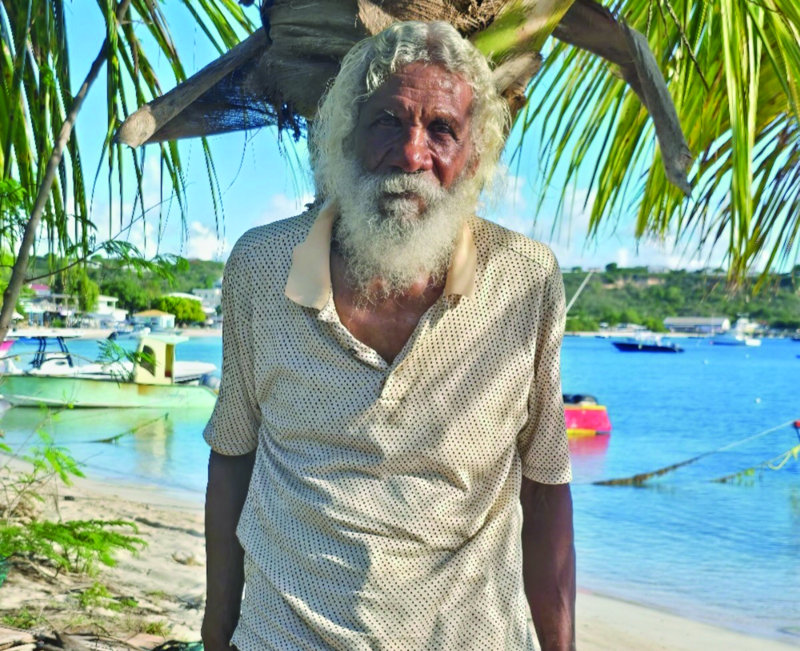
Edwin “Ed” Carty has spent most of his life fishing the waters around Anguilla. He has watched fishing grounds change, catches get smaller and fishermen put out more gear in the hope of bringing home what once required far less effort.
Now, he is asking a fairly uncomfortable question: what happens when there is simply less left to catch?

Carty, a Sandy Ground fisherman, boat racing pioneer and cultural advocate, was recently honoured with the Malliouhana Poetry Culture Bearer Award under the theme “Salt In De Blood”. His connection to the sea, however, goes back long before the award.
“I was born on the beach,” Carty said.
His father, William Elliot Carty, was a sailor and boat builder. When his father died when Carty was 16, he was left with boats and charts and, in many ways, the foundations of the life he would build for himself.
While many Anguillians of his generation travelled overseas in search of opportunities, Carty stayed. He wanted to fish. He learned the waters with charts and a compass, studying fishing grounds, offshore banks and the different species found around them.
Making a living from it was not always straightforward. He remembers bringing hundreds of pounds of fish ashore and having to find markets for his catch, eventually developing connections with hotels in St Martin and elsewhere before establishing his own fishery in Anguilla.
That lifetime on the water shapes the way he looks at the fishing industry today.
Carty remembers a sea that could produce considerably larger catches. He recalls mahi-mahi weighing 15, 20, 25 and even 30 pounds. Today, he says, fishermen are often seeing much smaller fish.
He also remembers fishing grounds where marine life was abundant and offshore waters alive with birds and tuna feeding at the surface. Some of those sights, he says, have become much less common.
After spending about 2 years away from the water because of illness in 2012, Carty returned to an area he remembered as being full of fish and was stunned by what he found.
“There was hardly any fish,” he recalled.
These are Carty’s observations rather than scientific stock assessments, but they raise a question that Anguilla cannot afford to ignore: are fishermen increasingly working harder simply to maintain catches from a resource that is becoming more pressured?
Carty believes the amount of fishing effort has changed significantly. He compares the relatively small number of pots and deep-water traps he used in the past with the much larger quantities of gear being used today.
Lobster is one of his biggest concerns.
He remembers using around 25 lobster pots and being able to bring in a substantial catch. Today, he says, fishermen can use hundreds of traps without necessarily seeing a proportionate increase in what they bring home.
For Carty, that is a warning sign rather than an invitation to put out even more traps.
His philosophy is straightforward – “Don’t take out the little ones.”
He says that when he fished, he would release juvenile grouper rather than keep them, because the fish needed time to mature and reproduce. He applies the same thinking to lobster and is particularly concerned about juvenile spiny lobsters being harvested before they have had the opportunity to grow.
The principle comes from what he says his father taught him: “To respect the sea.”
Carty compares the ocean to a farm. You cannot continually harvest a farm without giving it time to produce again. If everything is taken before it reaches maturity, eventually there is nothing left.
That is why he believes fishermen need to fish differently, rather than simply fish more.
It is also how he says he continues to operate. Carty still fishes because he loves it, but says he goes out about twice a week and uses only a small number of deep-water traps, moving them between fishing grounds rather than repeatedly working the same area.
He does not believe fishermen should be blamed for everything. Hurricanes and other natural forces affect marine life, he acknowledges, but he believes human activity is also putting considerable pressure on the environment. That includes what happens to the reef.
Carty is particularly critical of the use of spearguns around reefs and recalls warning people against repeatedly taking fish from a particular area. He later returned and says he saw fish coming back.
It is an anecdote rather than scientific evidence of cause and effect, but it captures Carty’s larger argument: give the marine environment a chance to recover and it may surprise us.
He is also concerned about the disappearance of something fishermen need before they can even catch fish — bait.
Carty remembers being able to catch a bucket or two of bait and leave to go fishing. Today, he says, when bait appears, some fishermen take considerably more, freezing it for later use. Some of that bait, he says, eventually goes bad and is wasted.
To him, the problem is obvious. If the bait is taken in large quantities every time it appears, there may eventually be less of it available.
And that has consequences beyond the fishing boat.
Anguilla’s fishing industry provides food and livelihoods, while the same marine environment supports tourism through its beaches, reefs, diving, snorkelling and boating. The Department of Natural Resources and Caribbean Regional Fisheries Mechanism (CRFM) have previously identified lobster as Anguilla’s most financially valuable marine species and raised concerns about declining nearshore lobster populations and increasing fishing effort.
Protecting the ocean, therefore, is not simply an environmental issue. It is an economic one, a food-security issue and a cultural one.
That is what makes Carty’s concern about the future particularly important.
He remembers having the opportunity to grow up around boats, learn the waters and make a living from fishing. He worries about whether the next generation will have that same opportunity.
If the fish disappear, the loss will not be limited to fishermen’s catches. It will mean losing knowledge passed from one generation to another, a source of food and income, and part of the maritime culture that helped shape Anguilla.
Carty is not calling for an end to fishing. He is calling for enough restraint to ensure there is something left to fish.
The sea has provided for Anguilla for generations. The question now is whether we are willing to provide for the sea in return.
By Janissa Fleming