 There was something worth paying attention to in the talent segment of Miss Anguilla 2026. Not simply because the contestants could sing, dance, act or perform impressive physical movements, but because of what they chose to say while doing it.
On 5th August, 2026, the talent segment of the Miss Anguilla pageant became a brief but revealing look at some of the experiences and pressures that can shape young people long before they ever step onto a stage.

The performances touched on self-acceptance, identity, resilience, fear, perseverance and the impact of parental conflict on children. At first glance, these might sound like familiar pageant themes. Look a little closer, though, and they are also very real parts of growing up.
 That, to me, is what made the segment interesting.
Akema Carty, who would go on to be crowned Miss Anguilla 2026, centred her presentation on self-acceptance. Sharianne Francis explored identity and the search for authenticity, while Amelia Olivacce considered what happens when doubt and disappointment make it tempting to give up. Ashley Derich represented overcoming fear and learning to push beyond perceived limitations.
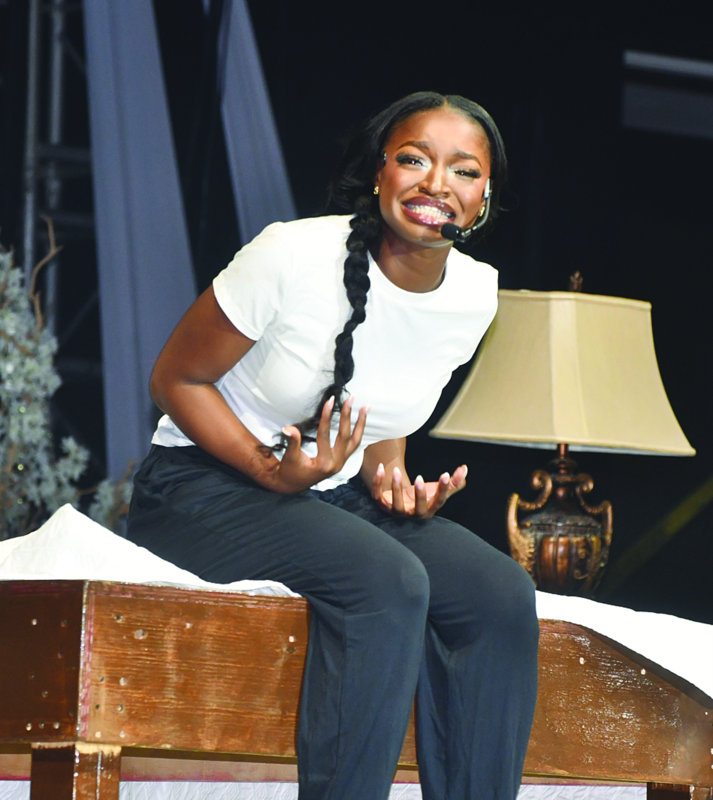
Then came Kishante Connor-Carty’s performance, which moved the conversation from the individual to the family as she portrayed a child caught between conflicting parents and the emotional pressure of being made to feel that choosing sides is somehow necessary.
It was an uncomfortable subject, and that was exactly why it mattered.
 We tend to think of childhood as a protected space, but children are often more aware of what is happening around them than adults realise. They may not understand every detail of an argument, but they understand tension. They know when the atmosphere at home has changed. And when adults are in conflict, children can end up carrying feelings that were never theirs to begin with.
Connor-Carty’s performance did not need a complicated explanation. The image of a child caught in the middle was enough.
It also opened up a wider question about the things we expect young people to cope with quietly.
Self-acceptance, for example, can sound like a simple motivational phrase until we consider how difficult it can be for a young person to feel comfortable in their own skin. There are expectations from family, school, friends and the wider society, along with the constant comparison that comes with social media. In Anguilla, people are closely connected and reputations can travel quickly. Here, that pressure can feel even more personal.
Everyone knows someone. Everyone has an opinion. And sometimes it can feel as though everyone is watching.
 That makes Francis’ focus on identity particularly relevant. Her performance considered the temptation to measure ourselves through popularity, appearance, achievement or the expectations of other people. The challenge, ultimately, is learning to distinguish between who we are and who we think we are supposed to be.
For young people, that is not necessarily an easy distinction to make.
The pressure does not stop once a young person leaves secondary school either. Olivacce’s emphasis on resilience and Derich’s portrayal of fear and overcoming obstacles both speak to the realities of entering adulthood — the uncertainty of university, employment, relationships, ambition and the possibility that things will not always go according to plan.
There is a tendency to praise resilience without asking why so many people need so much of it.
Young people are often told to be strong, work hard, keep going and bounce back. Those are worthwhile qualities, certainly. But there is also value in asking whether they have enough support when they cannot simply “bounce back” on their own.
That is where the talent segment for me became more than entertainment.
The contestants were using the language available to them — performance, music, dance and movement — to communicate experiences that many people may recognise but do not necessarily discuss often or openly.
And there was something particularly fitting about that happening during Summer Festival.
Summer Festival is one of those periods when Anguilla puts its personality on full display. Music is louder, costumes are brighter, the streets are busier and the island celebrates itself. Yet alongside all that celebration are the quieter realities of island life.
 Families have difficulties. Young people struggle with confidence. People experience failure. Children absorb tensions they cannot control. Adults worry about whether they are doing enough for the next generation.
None of that disappears because the music starts.
That is why the talent performances worked. They did not try to pretend that growing up here is always uncomplicated.
There was also a common thread running through the performances: the possibility of moving forward.
Self-acceptance suggests that we do not have to spend our lives trying to become somebody else. Resilience suggests that failure does not have to be the end of the story. Overcoming fear suggests that limitations can be challenged. And the message about parental conflict suggests that adults can make different choices when they understand how deeply their behaviour can affect children.
None of these are revolutionary ideas. But sometimes familiar truths are worth hearing again, particularly when they come from young people themselves.
For me, that was the part of the talent segment that stayed with me. The performances were carefully prepared, beautifully presented and designed for a competition, but underneath all of that were stories about ordinary people trying to navigate ordinary difficulties.
It is easy to watch a pageant and focus on the obvious things — who had the best performance, who wore the most memorable gown or who answered a question most convincingly.
But we should also pay attention to what contestants choose to put on that stage in the first place.
For a few minutes, the pageant stage became something else: a place where young women could put some of the quieter realities of growing up in front of a crowd and say, in their own ways, that these things matter too.
By Janissa Fleming