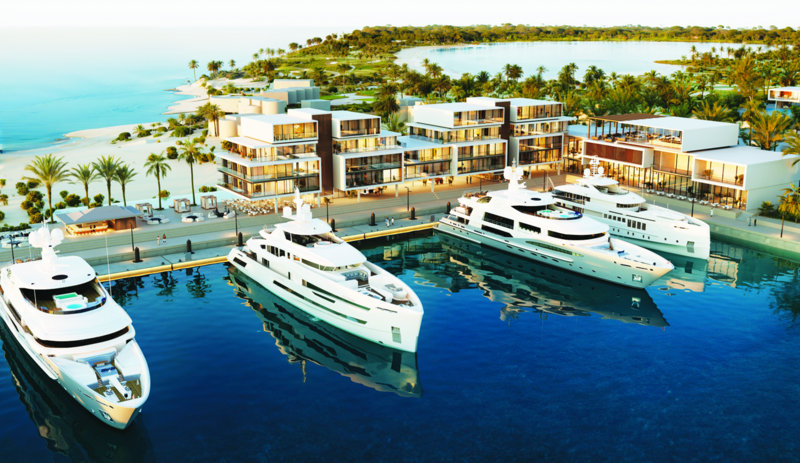
 For years, Port Nimara has been one of those projects that Anguillians have heard about, watched, questioned and waited to see take shape. Now, with the first major piece of its marina infrastructure in place, the development is beginning to look less like a distant concept and more like a destination on the horizon.
The latest picture of where the project stands emerged during an interview with The Anguillian on 18th August 2026, with David Mizrahi, CEO of SF Investments and Managing Partner of the Port Nimara development. His account points to a project that is considerably more compact than originally envisioned, but whose ambitions for Anguilla remain substantial — particularly the creation of a yachting industry that could extend well beyond the marina itself.


The interview followed Port Nimara’s private preview on 7 August 2026, when invited guests were taken onto the water to see the progress first-hand. The marina’s A-Dock, the largest floating dock within the development, has been installed, marking a significant step towards the planned November 2027 opening.
There is still a considerable amount of work between that first dock and the arrival of the first yachts, according to Mizrahi. The marina basin is being excavated and its perimeter wall constructed, with completion expected between May and July 2027. Remaining pontoons are due to be installed and equipped thereafter, followed by commissioning in September and October 2027.
The first phase will be focused largely on the marina itself. The restaurant building, immigration facilities and marina management facilities are expected to be ready around the time the first yachts arrive. The hotel will not be completed by then, however, and construction is expected to continue while the marina becomes operational. Villa construction is also expected to begin during 2027.
Less visible than the construction is the extent to which the project has changed from the Port Nimara first imagined years ago.
After SF Investments became involved around 2023, the development underwent a complete redesign. What Mizrahi described as an originally “expansionist” concept was scaled back into a more compact development. A hotel once planned at roughly 200 rooms or more is now expected to have approximately 62 rooms, with fewer villas and significant changes to the architecture and marina design.
The marina itself is planned for 118 boats, although 6 berths will be retained for operational purposes, leaving 112 available for sale. Around 16 or 17 berths are currently sold, reserved or progressing through documentation. The 6 retained berths will also provide flexibility for tender boats and larger yachts that may anchor offshore rather than enter the marina.
A change in Anguilla’s legislation during 2026 has added another dimension to the marina. Berths can now be individually owned as real estate rather than simply leased, potentially allowing owners to resell them as assets. Foreign purchasers will still have to satisfy the requirements governing foreign ownership of land in Anguilla.
But beyond the property and construction aspects is the question that may matter most locally: what kind of economic activity will the marina generate once the yachts begin arriving?
Port Nimara’s existing projection is approximately 200 direct jobs and 500 peripheral jobs once the development is fully established. The larger proposition, however, is the specialist economy that could grow around those yachts.
Mizrahi outlined that a superyacht does not arrive needing only a berth. It can require engineers, electricians, electronics specialists, maintenance crews, catering, yacht support and a range of technical services. As Anguilla has traditionally built its tourism reputation around hotels, villas, beaches and hospitality, this represents a different category of opportunity.
The developers envision Anguillians being trained for those roles, either through specialists coming to the island or through Anguillians gaining expertise abroad and bringing it home. The intention is that those skills could eventually support businesses throughout Anguilla rather than remaining confined to Port Nimara.
That could also mean existing businesses finding new customers. Yacht crews may need accommodation, restaurants, transportation and other services away from the marina, while local companies could become suppliers to the growing yachting sector. The development’s economic footprint, therefore, is being positioned as something that could spread across the island.
Mizrahi’s stated ambition is ultimately to see Anguilla recognised not simply as a place where yachts stop, but as a genuine Caribbean marina destination. He described the goal as creating an industry that is “for Anguillians and by Anguillians”.
There are practical considerations alongside that ambition. Port Nimara plans to produce its own water through desalination and operate its own wastewater management plant. Electricity presents a more complex challenge: Anguilla currently does not have sufficient capacity to supply the marina’s full requirements, and discussions are continuing over how the development and the island’s electricity system can work together.
Environmental monitoring is also part of the project, covering water quality, fish and other animals, plants and other environmental indicators.
And despite its high-end positioning, Port Nimara is not being presented as a waterfront reserved exclusively for yacht owners and resort guests. Plans include shops, restaurants and a promenade around the marina, with the intention of allowing members of the public to visit and experience the waterfront. Local businesses are also being considered for space within the development.
There is a youth element too. Work has been taking place with the Government of Anguilla and young sailors, with the developers seeing potential for the growth of sailing and new opportunities for young people already involved in the sport.
For now, Port Nimara remains very much a work in progress. The first dock is in the water, but the hotel, villas and much of the marina infrastructure are still ahead.
The project’s ambition, however, is reaching beyond creating another luxury development on Anguilla’s coastline. Its developers are betting that the arrival of a superyacht marina can bring with it a new set of skills, services and businesses — and potentially give Anguilla something it has never had before: an established yachting industry of its own.
By Janissa Fleming