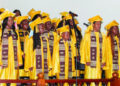
The polarization of our people continues and politics is playing a major role. A warning was sounded in the editorial titled “Polarization by Politics – Must it be?” published on 4th October, 2024. It is worth repeating today and is therefore reprinted below.
Polarization by Politics – Must it be?
Anguillians are savaging each other on social media, all in the name of politics. It is said that we learn from experience, but that does not mean that you must personally experience something to learn from it. There is also great value in learning from the experience of others.
The polarization of the people in other Caribbean territories, because of politics is not something to be admired or to aspire to. In some countries gang violence has been associated with politics. This is certainly not the way Anguilla should go. But is polarization becoming embedded?

Everything in Anguilla today appears to be viewed through a political lens. Simple truths will not be accepted by some, no matter how glaring, if it reflects badly on the political party they support. Mere silence on their part will not suffice in the face of these simple truths. Instead, long diatribes must follow in defence of their political party. Reason flies out the window as justification, which is devoid of intelligent argument is often put forward in the hope of persuading persons to ignore simple truths.
Anguilla’s descent into a polarized society where persons are willing to support their party’s decisions and actions without question is a reflection on both the politicians and the electorate. Politicians often refrain from acquainting persons with their failings in relation to adherence to good governance and instead seek to excuse their actions because of special circumstance or by referring to previous questionable conduct of others. Supporters, on the other hand, fail to exercise their reasoning powers and instead are happy to support their party without question.
Political parties solidify their supporters unquestioning allegiance through tactics often employed by sports teams. Colours, chants and locality are constantly referenced to create a sense of belonging, recognition and even rivalry among supporters such that supporters are only concerned that their party comes out on top, no matter what. The result of this behaviour, if it becomes an embedded part of our culture, will be a state of affairs that Anguilla should try hard to avoid.
We are on the wrong path when public officers are made to feel uncomfortable by the remarks of ministers of government about the colour of their clothing, which happens to be the colour associated with an opposing political party. We are on the wrong path when actions, which would be soundly condemned if perpetrated by ordinary persons, are excused and justified by party supporters when perpetrated by a person of significant standing in their political party. We are on the wrong path when persons who should be able to be credited with some intelligence prefer to further our political polarization by supporting and promulgating false narratives, rather than providing true and tested information for the consideration of others.
With the knowledge of what exists in other countries, where political polarization is embedded in their culture, why is it that we in Anguilla appear willing to create such an environment? Many of us have heard stories of persons visiting a Caribbean island and being warned not to venture into certain areas because of the colour T-Shirt being worn. Some persons can personally speak of this experience. Is this what we want for Anguilla? I hope not. The colour of a person’s clothing should never cause us to display negative feelings or actions towards them. While politics can be naturally polarizing in that it seeks to persuade persons to support different views and policies it should never result in the destruction of community ties, relationships and ordinary acts of civility among persons. Let us learn from the experience of others.