As we reached the final sections of the 1982 Anguilla Constitution Order, while some might question what was included, other constitutions may reveal omissions or clarifications to strengthen our democracy. Of note is the concept of supremacy, which has been heralded as a hallmark of the Constitution of the Republic of South Africa (1996).[1] In its Founding Provisions, it states, “This Constitution is the supreme law of the Republic; law or conduct inconsistent with it is invalid, and the obligations imposed by it must be fulfilled.”[2] The words are clear: “is” and “must” are not equivocal.
 Constitutional “Supremacy” for Anguilla – Except for “Any law”?
The supremacy of the Anguilla Constitution Order is implied by the monarch’s ultimate power “as to the interpretation of this Constitution” in any civil or criminal proceedings, which would logically include any claims of inconsistencies. The supremacy of the Anguilla Constitution is also implied as an “Order” by “Queen’s Most Excellent Majesty in Council”; whereas other powers are derived from the Order, including those of the Governor and Assembly to pass “any law” under its auspices. [3]

That said, “any law” is mentioned repeatedly in reference to how future laws could present conditional changes to our Constitution, once passed.[3] As such, while supremacy may have been intended, the language is frequently vague and would require extraordinary resources and luck to challenge the constitutionality of any law.
Constitutional “Supremacy” in South Africa – Except for Section 36?
Chapter 2 of the South African Constitution establishes human rights and begins, “This Bill of Rights is a cornerstone of democracy in South Africa. It enshrines the rights of all people in our country and affirms the democratic values of human dignity, equality and freedom…The state must respect, protect, promote and fulfil the rights in the Bill of Rights.”[2]
The “Application” section continues, “The Bill of Rights applies to all law, and binds the legislature, the executive, the judiciary and all organs of state…” But. Too good to be true? It continued, “The rights in the Bill of Rights are subject to the limitations contained or referred to in Section 36, or elsewhere in the Bill.”[2] Before reading Section 36, let’s look at some of the rights they included.
Progressive Protection of Human Rights
The South African government describes its Constitution as, “…one of the most progressive in the world and enjoys high acclaim internationally. Human rights are given clear prominence in the Constitution [and it]…is the supreme law of the land. No other law or government action can supersede the provisions of the Constitution.”[1] Many of the “freedoms” in the Anguilla Constitution are consistent with those in South Africa; however, the latter articulates more rights with seemingly more clarity.
Fundamental Rights and Freedoms
Similarities with our Constitution include “equal protection and benefit of the law.” While ours cites “race, place of origin, political opinions, colour or creed, or sex,”[3,4] their additional exclusions forbidding state discrimination include “pregnancy, marital status, ethnic or social origin,… sexual orientation, age, disability, religion, conscience, belief, culture, language and birth.”[2]
Other examples of South African rights that may be implied but not enshrined in the Anguilla Constitution include: … “bodily and psychological integrity, which includes the right ¬to make decisions concerning reproduction; to security in and control over their body; and not to be subjected to medical or scientific experiments without their informed consent.”[2]
And “…Everyone has the right to privacy, which includes the right not to have their person or home searched; their property searched; their possessions seized; or the privacy of their communications infringed.”[2] That’s it. Our privacy clause has five subsections of exceptions, including “for the purpose of any tax”.[3] Thus, “constitutional” property searches may seem harmless for packages at ports for duties, but this exception also allows warrantless, random business searches, seizure of records, and computers, for GST and now, General Services Tax! [5] What else could be searched for a future tax?
Rights Beyond Our Rights and Freedoms…
In fact, there are South African rights beyond those enshrined for Anguilla, too many to mention here. However, notable entries include, “an environment that is not harmful to their health or well-being”; to “enable citizens to gain access to land on an equitable basis”; “access to adequate housing…[and] No legislation may permit arbitrary evictions.” They also include, “access [but not free] to ¬health care services, including reproductive health care; sufficient food and water; and social security, including, if they are unable to support themselves and their dependants, appropriate social assistance”; and “No one may be refused emergency medical treatment.”[2] Know anyone sent to the bank before an xray?
Numerous, clear rights for children [under 18] are followed by the right to a “basic” education. And they allow “anyone acting in their own interest…on behalf of another person who cannot act in their own name… acting as a member of, or in the interest of, a group or class of persons… in the public interest; and an association acting in the interest of its members” to approach the court to protect their rights.[2] As such, “class action” challenges appear to have standing. Hmm. A class of taxpayers?
Moreover, transparency is enshrined with “the right of access to ¬any information held by the state”; whereas, any arrested, detained or accused person has the right not to provide information, to remain silent, and not “to be compelled to make any confession or admission that could be used in evidence against that person.” And, such persons have the right to, “a legal practitioner assigned to the detained person by the state and at state expense, if substantial injustice would otherwise result, and to be informed of this right promptly… and not to testify during the proceedings.”[2] Not so in Anguilla!
Limitation of South African Rights
While our Constitution is muddled by “save as may be authorised by law” or “to the extent that the law makes provision” exceptions, some include “the interest of defence, public safety, public order, public morality or public health.”[3] The South African Section 36 states that rights, “may be limited only in terms of law of general application to the extent that the limitation is reasonable and justifiable in an open and democratic society based on human dignity, equality and freedom, taking into account all relevant factors, including the nature of the right; the importance of the purpose of the limitation; the nature and extent of the limitation; the relation between the limitation and its purpose; and less restrictive means to achieve the purpose…” They also enshrined the “Constitutional Court” where at least eight judges have final say as to the constitutionality of other laws, amendments, whether Parliament or the President is negligent…[and] “any issue involving the interpretation, protection or enforcement of the Constitution.”[2] But who has the resources to even challenge “constitutional” powers to infringe on rights we thought we had for a tax imposed against our will?
…and the General Services Tax (GST)
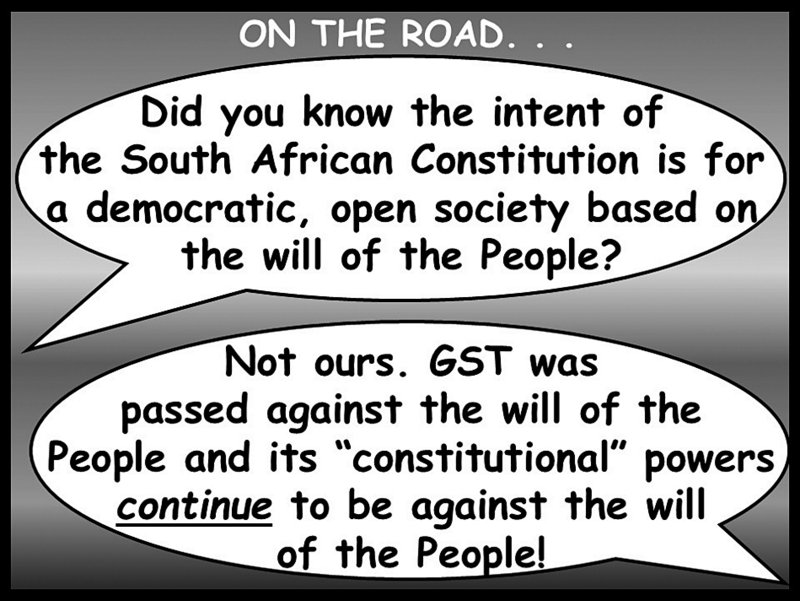
So. Apart from the absence of forced oaths, self-incrimination, property searches and seizures and countless threatened GST penalties made legal “for the purposes of any tax” [3] – perhaps the most elegant distinction from ours is in the preamble to the South African Constitution: It states the intent to, “lay the foundations for a democratic and open society in which government is based on the will of the people, and in which every citizen is equally protected by law.”[2] GST was passed against the will of the people, and the General Services Tax Act of 2025 continues its legacy of intrusive powers that remain against the will of the people, and in which every citizen is at the mercy of one civil servant.[5]
Repeal General Services Tax – and pass a balanced budget bill. Now.
This article reflects issues raised on July 5, 2021, at the House Select Committee on GST Public Hearing. [1] https://www.gov.za/constitution website; [2] Republic of South Africa Constitution (1996); [3] Anguilla Constitution Order 1982; [4] 1990 Anguilla Constitutional Amendment; [5] General Services Tax Act, 2025.