In addition to elusive “freedoms” and the Governor’s, Deputy Governor and Attorney General’s powers, the 1982 Anguilla Constitution Order also established the House of Assembly and the Public Service. In Chapter VI, the Public and Judicial Service Commissions are enshrined, along with their roles.[1] Guess which appointee gets to appoint the ones who appoint appointees?
Public Service Commission (PSC)
The Governor! Section 65 proclaims, “There shall be in and for Anguilla a Public Service Commission which shall consist of five [5] members of whom three [3] shall be appointed by the Governor, acting in his discretion, and two [2] shall be appointed by the Governor, acting after consultation with the public service staff associations.” [1] But such “associations” are not defined.

 It continued, “The Governor, acting after consultation with the [Premier], shall appoint one of the members of the [PSC] to be Chairman …[but must not be] …a member of, or a candidate for election to, the Assembly, or holds or is acting in any public office.” [1,2] So, the Premier has no say in the members, only the Chairman, regardless of whether the Premier finds any of them suitable, at all?
Further, “The office of a member of the [PSC] shall become vacant—at the expiration of two [2] years from… appointment or such earlier times as may be specified” or through resignation, or becoming an Assembly member, candidate or public office holder – or if the Governor “directs that he shall be removed” at his discretion if unable to perform or “for misbehaviour.” That is also left to the Governor’s discretion, where he can appoint a replacement to serve “until he is notified” by the Governor that the “circumstances” of the appointment no longer apply; however, if the Chairman is removed, “consultation” with the Premier is indicated but not required for a replacement.[1,2]
And, the competition for paid board seats seemed well entrenched by 1982, in lieu of patriotic service from self-sustaining community leaders. Section 65 concludes: “There shall be charged on the revenues of Anguilla and paid there out to the members of the [PSC] such emoluments as may be prescribed by any law… Provided that the emoluments of a member of the Commission shall not be reduced during his continuance in office.”[1] Never reduced? Of course not! Let the taxpayers working hard to feed their families and pay their loans make sure such lofty appointees never share a single sacrifice, no matter the economic context! And – it seems there are no rules to prevent re-appointment for “continuance”!
Power to appoint, etc., to public offices
Section 66 stays true to form: “Power to make appointments to public offices and to remove and to exercise disciplinary control over …such offices shall vest in the Governor, acting in his discretion in relation to the offices of [the Deputy Governor] and Attorney-General and …all other offices acting after consultation” with the PSC; however, the Governor must also “consult” with the Premier to appoint “a permanent secretary or head of a department…” [1,2,3] Translation: He can legally ignore that input.
In turn, having appointed all its members, he may also engage the PSC in “consultation” and publish “regulations” that allow him to “delegate to any member of the Commission or any public officer or class of public officer …as may be prescribed in the regulations, any of the powers vested in him by the last foregoing subsection…” with the exceptions of judicial officers (Section 68) and “any office in the Police Force below the rank of Assistant Superintendent to the extent that the Chief of Police or some other officer of the Police Force is empowered by any law…”[1]
So “any public officer” could be allowed to “make appointments to [most all] public offices and to remove and to exercise disciplinary control over persons holding or acting in such offices” but not the Premier or any Minister? That’s the law, except for General Orders, but that is a topic for another installment.
Judicial Service Commission
In case anyone else ever wondered, Section 67 established the, “…Judicial Service Commission which shall consist of—the Chief Justice, who shall be Chairman; another judge of the Court of Appeal or the High Court nominated by the Chief Justice after consultation with the Governor; and the Chairman of the [PSC].”[1] For those interested in liberal democracy,[4] having the Chief Justice merely consult with the Governor when choosing another judge is a hint of independence for the judiciary from the executive bodies in our government. Well done!
Power to appoint, etc., to judicial offices
But. Section 68 withdraws such independence! It reads, “Power to make appointments to the offices to which this section applies and to remove and exercise disciplinary control over persons holding or acting in such offices shall vest in the Governor, acting after consultation with the Judicial Service Commission.” Applicable “offices” span from the “Magistrate, to any office in the public service of any registrar or other officer” from the High Court “…to such other offices in the public service, for appointment to which persons are required to possess legal qualifications…”[1]
Commissions, Public Servants…
While Section 66 vested appointment powers with the Governor, including discretion to “delegate” to PSC members, mere “consultation” may be ignored – even for the judiciary, as stated in Section 68.
We are reminded of Section 28 (2), which affirmed, “The Governor shall not be obliged to consult with nor act upon the advice of the Executive Council with respect to… the appointment (including the appointment on promotion or transfer, appointment on contract and appointment to act in an office) of any person to any public office, the suspension, termination of employment, dismissal, or retirement of any public officer or taking of disciplinary action in respect of such an officer, the application to any public officer of the terms or conditions of employment of the public service (including salary scales, allowances, leave, passages or pensions) for which financial provision has been made…”[1] Hmm. At what point do the Governor’s salary powers constitute taxation without representation?
The Premier, PSC…and the General Services Tax (GST)
So, a British appointee without the Premier or Executive Council can appoint a public officer through an appointed PSC – and pass laws after a single reading that can revise the “freedoms” of the Constitution, as in the General Services Tax Act of 2025. By law, an appointee without legal qualifications can legally: access premises (including law offices); seize books, records or computers without a warrant or notice; place anyone – regardless if liable for tax – under oath; make assessments 5 years after becoming “aware” of a claim; issue statements “with the effect of a civil judgement”; demand 50% of any disputed amount to “consider” it; demand security, seek court orders to prevent travel, seize goods (and sell them); delay taxpayers for months to appeal to other appointees, to merely pay interest if they prevail, with the burden of proof on anyone pursued by the public officer who can institute criminal charges and levy fines, and more![5] And public officers made the People wait months to simply exempt goods from GST, making a mockery of our leaders by replacing it with the General Services Tax – with all of its predatory powers! Ta dah!
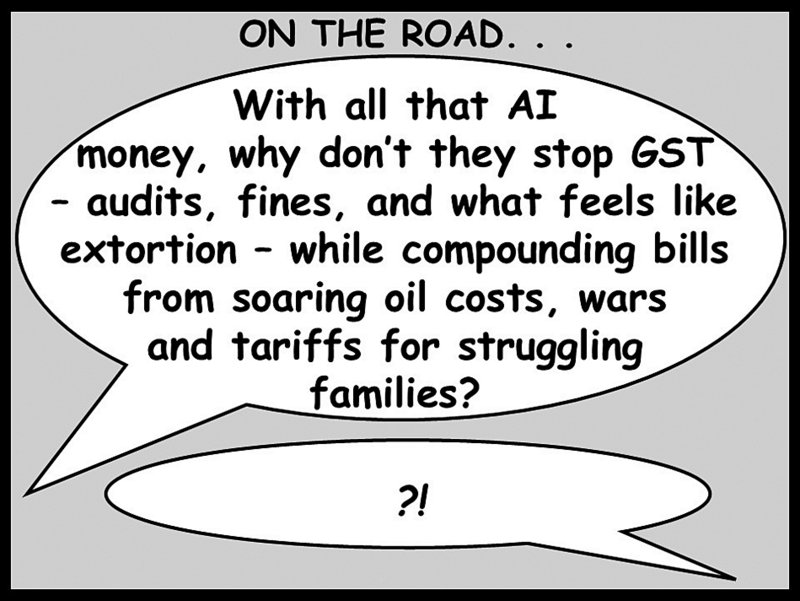
Apart from accommodations taxes, which should be reinstated as they were, General Services Tax is no longer necessary due to AI revenues. Why? Salaries and expenses are now fully dependent on them, beyond any tax. So how much longer will our leaders leave the General Services Tax Act in place – with no say in an appointee appointed by layers of appointees? And… With all that AI money, why don’t they stop GST – and its powers for audits, fines, and what feels like extortion – while compounding bills from soaring oil costs, wars and tariffs for struggling families? Why?
Repeal General Services Tax – and pass a balanced budget bill. Now.
This article reflects issues raised on July 5, 2021, at the House Select Committee on GST Public Hearing. [1] Anguilla Constitution Order 1982; [2] Anguilla Constitution (Amendment) Order 2019 [3] Anguilla Constitution (Amendment) Order 1990; [4] https://www.britannica.com/topic/liberal-democracy; [5] General Services Tax Act, 2025.