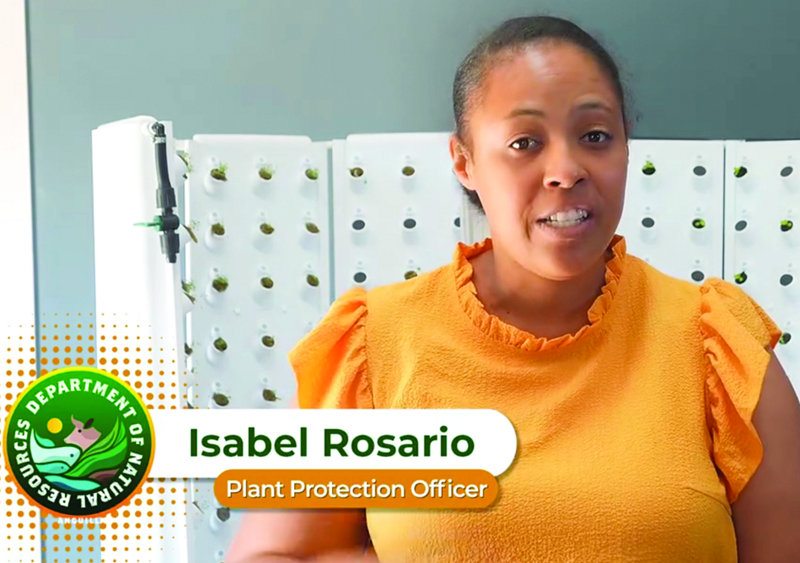
 Plant Protection Officer at the Department of Natural Resources, Isabel Rosario, recently took time to explain the benefits of the use of the Flex-Farm system of agriculture which acts a convenient, efficient means for enabling food production.
She referred to the Caribbean Climate-Smart Accelerator (CCSA) partnership with Folk-Farms and the Government of Anguilla in which a pilot project was launched in 2023 to introduce hydroponic “Flex Farms” for sustainable, year-round food production.
According to Ms. Rosario, this project has aimed to promote food security and sustainable agriculture by using technology and best practices to strengthen community collaboration, to create livelihood opportunities for women and youth, and to support subsistence farmers with innovative hydroponic systems.
In addition, she said that the project also seeks to educate students through first-hand agriculture learning and encourage private sector support for local farmers and locally produced food.

“The heart of this project lies in six vertical indoor hydroponic units called the Flex-Farm that has been integrated in the daily routine of participating schools as well as residents of the juvenile centre,” Ms. Rosario explained.
“The systems are housed in classrooms,” she continued, “and provides a climate-controlled environment suitable for indoor farming. Under the guidance of the dedicated teachers, staff and the project lead, the students and residents follow instructions and manage the system themselves.”
She noted that from the inception of the project to the present, over one hundred participants, both male and female, between the ages of 9 and 16 have taken part in the initiative. She said that this number of Flex-Farm users for food production also includes adult participants.
Ms. Rosario mentioned that the students interested in utilizing the Flex-Farm system have received training through 2 half-day workshops as well as ongoing classroom instructions.
“In making contributions to sustainable food production and food security in Anguilla, the Flex-Farm has demonstrated that high quality production of leafy greens like lettuce, kale, pak choi, and arugula, as well as herbs like mint, thyme, and parsley can be achieved in non-traditional indoor environments with minimal specialized labour,” Ms. Rosario claimed.
She remarked that this “farm to table” experience has encouraged entrepreneurial thinking among students and staff while helping students appreciate and consume fresh foods that are free from chemicals and preservatives.
Additionally, Ms. Rosario mentioned that foods grown through the Flex-Farm system help to reduce the carbon footprint of food production. It supports sustainable practices by using significantly less water than traditional farming methods, and it utilizes energy efficient LED lighting. “The Flex-farm can also be powered through solar energy, thus further enhancing efficiency and sustainability,” she said.