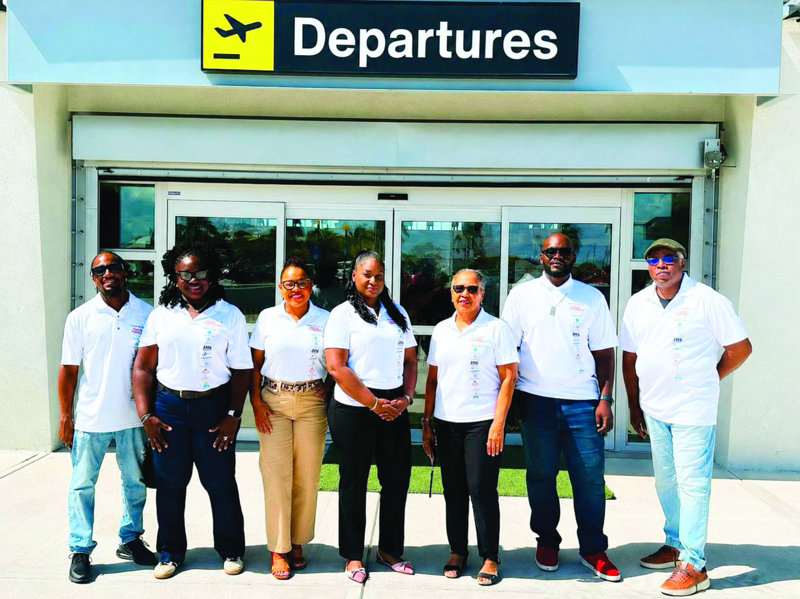
There is a particular kind of heat that settles over Nevis in early July, and this year it came scented with mango. On an island that grows more than forty varieties of the fruit, the first weekend of the month belongs to it entirely: mango in the cocktails, mango on the grill, mango folded into things you would never expect it to belong in, until suddenly it does. For four days, the whole of Nevis becomes an open-air tasting menu. And on Sunday, July 5th, when the festival gathered itself into its grand finale, “For the Love of Mangoes,” the signature event that fills the day with cooking, music, and the good-natured roar of a cross-cultural crowd, a small team from Anguilla stepped up to the competition tables and quietly announced that their island had arrived.
They would leave with a second-place finish. But anyone who was there will tell you the scoreboard only caught half the story.
A dream with soil under its fingernails
To understand what Team Hook & Harvest was really cooking for, you have to go back to Anguilla, and to Dr. Carissa Webster-Lake, who in 2025 gave a name and a shape to something the island had always felt but never quite organized. Hook & Harvest began as a farm-to-plate celebration (a movement, really) built on a simple, stubborn conviction: that the best of Anguilla is already here. It is caught off its own reefs, raised on its own land, grown in its own gardens. The initiative set out to put the island’s young chefs, its farmers and its fisherfolk on the same stage, and to make the case that fresh, locally sourced food is not a luxury but the foundation of a healthier, stronger island life.
That vision was never meant to stay home. When the Nevis Tourism Authority extended an invitation to compete, Hook & Harvest saw more than a contest. It saw an “island-to-island” story, a chance to knit Anguilla’s culinary reputation into the wider fabric of the Leewards, one plate at a time.
“This is about putting Anguilla’s talent on a regional stage,” Webster-Lake said of the mission. “Our chefs are ready, and with a flavouring of good corporate citizens and partners, I know we will represent with pride and the art of Anguillian excellence.” They did exactly that.
Three chefs, one island
The team that boarded for Nevis was small but formidable, three chefs whose résumés read like a cross-section of Anguilla’s food scene at its most ambitious.
There was Chef Rakev Webster, founder of Rtaste Catering, a cook whose years in the United Kingdom gave him a rare fluency: the kind that lets a chef pivot across cuisines and dietary demands without losing his own voice. There was Chef Karimah Carty, a hospitality veteran of more than two decades, longtime culinary trainer at the Anguilla Community College and the force behind Remah’s Delights, a woman who has spent her career teaching others how good Anguillian food can be. And there was Chef Makeame Mussington, the youngest cook on the line at Sharky’s Restaurant, a rising talent who treats a plate the way a painter treats a canvas: every element placed, every colour earning its spot, nothing on the dish that isn’t built to taste as good as it looks. Chef Dean Samuel, no stranger to the local, regional and international culinary scene was the manager and anchor of this dynamic trio.
Together they represented something larger than three careers: the promise that Anguilla’s culinary future is not a hope but a fact already in motion.
Flame & Flavour
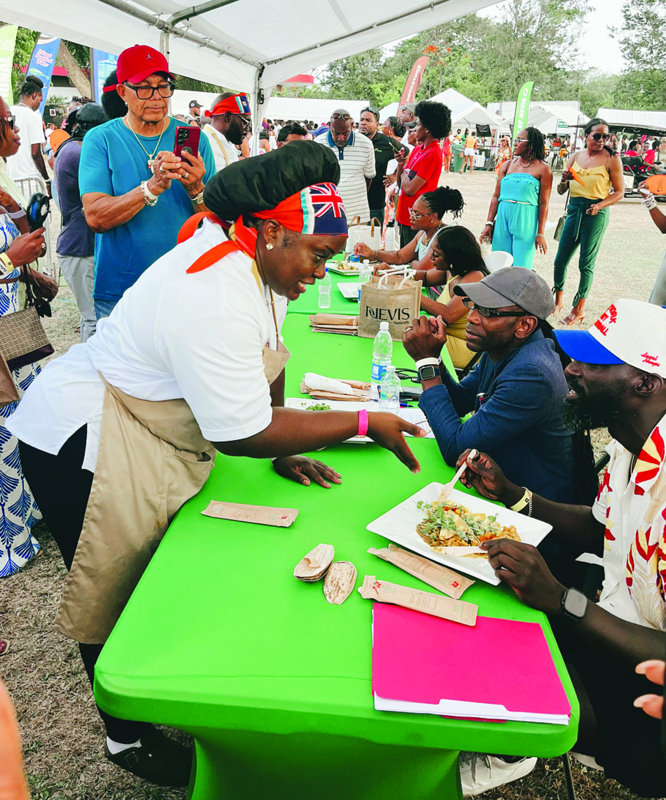
 The Chef Competition is the festival’s beating heart, and it does not make things easy. Under the eye of celebrity judge Chef Eric Adjepong (the Food Network personality and Top Chef finalist whose globe-spanning, West-African-rooted cooking has made him one of the most compelling voices in the modern kitchen) and three fellow judges, the competing teams were handed ingredients for a vegan dish and a mystery basket, then sent to work across two rounds. The single non-negotiable rule of the whole festival applied here too: mango, somewhere, somehow, in the dish.
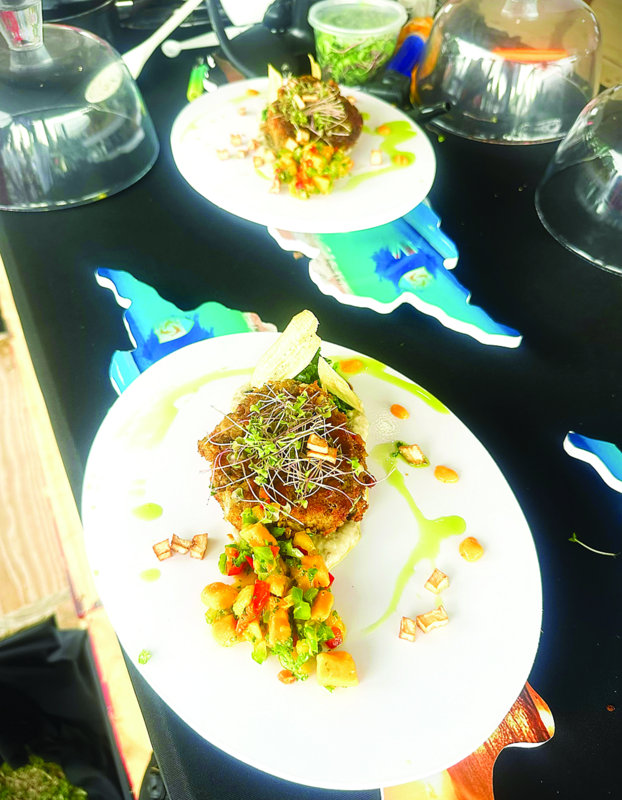
This is where nerve meets craft. Team Anguilla set the standard early with a creatively curated lentil dish, plated patriotically on a custom Anguilla plate that raised the bar past the burst of flavour. Then it was on to break the competition wide open. A mystery basket rewards the cook who can think sideways, who can look at an unfamiliar tangle of ingredients and see not a problem but a plate. Team Anguilla saw the plate. What they sent out drew the reaction every competing chef dreams of and few receive: tasting their dish, Adjepong stopped, let out an involuntary “Aw man” (the sound a person makes when a bite lands better than expected) and applauded both the flavour and the presentation. In a room full of accomplished regional talent, it became one of the afternoon’s defining moments.
When the results were read, the standings told a story of remarkable arrival. Host Nevis took first. St. Maarten’s team, led by Chef Renata de Weever with Junior Chef Jaenanena Joseph, took third. And there, wedged between two established programmes on their debut outing, stood Anguilla in second place, a first-time contender outperforming all but the home island, and separated from first by just six points in a 167 to 161 finish in favour of Nevis.
The award nobody handed out
Here is the part the official tally could not measure. If the Nevis Mango Festival had offered a people’s flavour award (a prize decided not by judges but by the sheer weight of the crowd’s affection and reaction to the taste and presentation of the dishes), Anguilla would have won it, and it would not have been close.
You could feel it in the way spectators drifted back toward the Anguilla station for second and third tastes, in the questions about who these chefs were and where, exactly, this “Hook & Harvest” had come from. The reception was profound and unmistakable: an island that arrived as a guest and left as a favourite. Team Anguilla did not simply cook well. It captivated, turning a competition appearance into an ambassadorship, and a plate of food into an argument for a whole destination.
For Team Anguilla, falling short means standing tall
It would be easy, and wrong, to frame second place as a loss. Growth, as one visiting official observed of her own team that day, is about testing yourself against those with more experience and more time in the game. By that measure, Anguilla did not fall short of anything that matters. A debut team, competing against seasoned regional rivals on unfamiliar ground, walked away a single podium step from the top, and with something no trophy confers: the hard-won, in-the-fire experience of having done it.
That experience changes the math for next year. Team Hook & Harvest now knows the rhythm of the mystery basket, the pace of the two rounds, the particular pressure of cooking for a crowd and a camera at once. They return in 2027 not as newcomers hoping to make an impression, but as the team everyone else will be watching: the favourites, and deservedly so.
This was an investment in Anguillian talent
None of it (not the travel, not the tables, not the moment under Adjepong’s applause) happens without the community that believed first. Team Hook & Harvest carried more than knives and ambition to Nevis; it carried the faith of a long roster of partners: the Anguilla Tourist Board, Republic Bank, Properties in Paradise, MotorWorld, Jerry’s Taxi, NAGICO, Kokoon Real Estate, Sharky’s Restaurant, Tranquility Beach, T-Shirt Max, Ron’s Sign Shop, Cap Juluca, A Belmond Hotel and the Anguilla Hotel and Tourism Association. Their support was, in the truest sense, an investment in Anguillian talent and in the future of the island’s culinary industry, and it paid a dividend measured in pride.
The team, for its part, offered warm congratulations to the festival’s winners and gratitude to the Nevis Tourism Authority for an event that so generously celebrates Caribbean cuisine, culture and regional friendship.
Long after the last mango cocktail was poured on Pinney’s Beach and the finale performance faded into the Nevis night, the thing people kept describing was a feeling: the sense that they had tasted something honest, something rooted, something distinctly Anguillian. That is the real harvest Dr. Webster-Lake’s vision brought home. Not a first-place ribbon, not this year. Something more durable: proof that when Anguilla shows up, it doesn’t just compete. It leaves a flavour behind.
And Nevis, this year, is still tasting it.