For many Anguillians, opening an electricity bill recently has become an unwelcome source of stress. At a time when families are already coping with higher food, fuel and living costs, the sharp increase in electricity bills has left many wondering what is causing the rise.
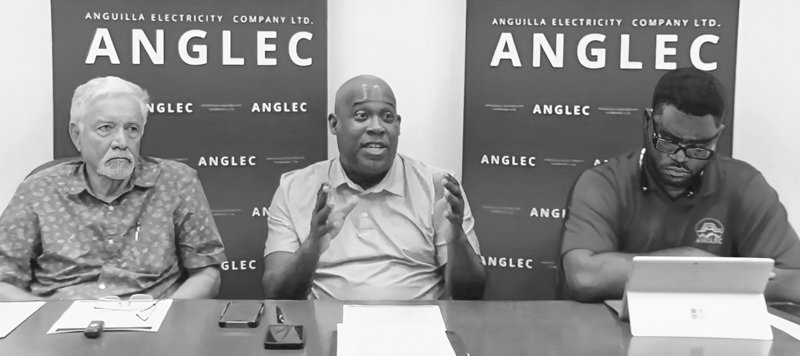
In response to growing public concern, ANGLEC’s newly appointed Chief Executive Officer, David Leonce, joined Board Chairman David Carty and Head of Information Technology Alvin Richardson in a press briefing on May 29th 2026 to explain the situation and outline the utility’s plans for the future.

While acknowledging the frustration felt by consumers, ANGLEC officials stressed that the issue extends far beyond Anguilla. Rising electricity costs are being driven largely by increases in global oil prices, ongoing geopolitical tensions, shipping disruptions and wider economic uncertainty.
As a small island that relies heavily on imported diesel to generate electricity, Anguilla remains particularly vulnerable to fluctuations in the international energy market.
Carty explained that fuel prices have increased dramatically in just a few months – rising from approximately $3.37 per litre in March to more than $5.20 per litre. Since diesel is one of ANGLEC’s largest operating expenses, those increases directly affect the cost of producing electricity.
Unlike larger countries with domestic fuel supplies or more diverse energy sources, Anguilla has limited options when fuel prices surge.
However, officials highlighted the Government of Anguilla’s role in helping to cushion the impact. Both Leonce and Carty described the government’s subsidy as critical in preventing even larger increases for consumers.
I.T. Head Jerry Richardson explained that residential customers currently receive a subsidy of $0.62 per kilowatt-hour on the fuel surcharge. With the surcharge standing at $1.04 per kilowatt-hour, households effectively pay about $0.42. Hotels and villas receive a subsidy of $0.39 per kilowatt-hour, leaving them responsible for roughly $0.65.
According to Richardson, customers whose electricity usage has remained relatively stable should see bills that stay close to previous levels despite the increase in fuel costs.
He also addressed confusion surrounding earlier bills, noting that some customers initially received statements showing the full fuel surcharge before government assistance was applied. ANGLEC is working to improve its billing system so customers can more clearly see both the surcharge and the subsidy on future bills.
A significant portion of the briefing focused on explaining how electricity bills are calculated, an area officials believe is often misunderstood.
Richardson said bills consist of two main components: the base electricity rate and the Fuel Cost Adjustment, commonly known as the fuel surcharge. While the base rate has remained relatively stable at around $0.63 per kilowatt-hour, the fuel surcharge rises and falls depending on fuel prices.
Both charges are multiplied by the amount of electricity consumed. As a result, even with government assistance, households that use more electricity will still see higher bills.
“The subsidy does not eliminate the need to conserve electricity,” Richardson emphasized. “It simply reduces the additional fuel-related cost.”
Although much of the discussion focused on immediate concerns, ANGLEC also outlined what it sees as the long-term solution: reducing Anguilla’s dependence on imported fossil fuels.
Leonce described renewable energy as essential to creating a more stable, affordable and resilient electricity system. Both he and Carty acknowledged that the transition toward renewable energy should have begun earlier to reduce the island’s exposure to the fuel price volatility now affecting consumers.
Nevertheless, officials said significant progress is now being made.
Central to those plans is a proposed 12-megawatt solar farm paired with battery storage. According to Leonce, environmental, engineering, geotechnical and social impact studies are currently underway and are expected to be completed by late 2026.
Once those assessments are finished, requests for proposals will be issued to engineering and construction firms, with construction potentially beginning in the second quarter of 2027 or earlier – if some stages of the project can overlap.
The solar project is expected to be developed in phases rather than all at once. This means portions of the facility could begin generating electricity before the full 12 megawatts are completed. Once approximately four megawatts are operational, ANGLEC may be able to retire one diesel generator, immediately reducing fuel consumption and operating costs.
The briefing also touched on rooftop solar systems for homes and businesses. While Leonce acknowledged their appeal, he pointed to challenges involving ownership, maintenance, insurance, storm damage and compensation for electricity returned to the grid.
He also raised concerns about fairness. If wealthier households are able to significantly reduce their reliance on the grid through private solar systems, the remaining costs of maintaining power lines, transformers and other infrastructure could fall disproportionately on those less able to afford them.
Officials also emphasized that rising fuel prices affect more than electricity. Carty noted that petroleum products play an important role in agriculture, particularly in fertilizer production, meaning higher oil prices can contribute to rising food costs worldwide. For an island that imports much of its food, this creates another layer of vulnerability.
At the same time, ANGLEC faces financial pressures of its own. Leonce revealed that the utility has absorbed some fuel costs in recent months rather than immediately passing every increase on to customers. However, he cautioned that this approach is not sustainable in the long term.
The company must continue maintaining infrastructure, preparing for storms, investing in renewable energy projects and meeting financial obligations, including loans secured through the Caribbean Development Bank.
Until renewable energy projects begin reducing the island’s reliance on diesel, officials say conservation remains the most effective action consumers can take.
Richardson identified air conditioners, refrigerators and other motor-driven appliances as some of the largest contributors to household electricity use. Small adjustments, such as increasing thermostat settings, turning off unused lights and reducing unnecessary appliance use, can make a noticeable difference in monthly bills.
For now, ANGLEC’s message is one of realism and reassurance. While government subsidies may provide short-term relief, ANGLEC believes the island’s long-term protection lies in reducing its dependence on imported fuel. The conversation is no longer just about electricity but also about affordability, resilience and how Anguilla can build a more secure future in an unpredictable world.
By Janissa Fleming