Why are we still thinking about what’s in (or missing) from our Constitution? Last September, our Premier asserted, “We have to progress with full-fledged constitutional reform. It is interesting because at this same time as well, many of the Overseas Territories are also revisiting their constitutional status and are seeking greater self-internal government. And so too we in Anguilla are along the same path.” [1]
Part of being a constitutional democracy means taking part in democracy! And one of the most elemental forms of democracy is when the People are empowered to have power through initiatives and referenda.
 “Self-internal Government”: Putting Bills on Ballots
If you think Anguilla must be independent to exercise “self-internal government” by proposing our own laws or to demand the repeal of enacted laws, think again! None of the US states are independent nations, and yet, “…26 states provide for a statewide initiative process, referendum process, or both. Washington, D.C. also has an initiative and referendum process. These types of ballot measures are known as citizen-initiated ballot measures.” [2]
To propose new laws or amendments to state constitutions, the “initiative process” recognises the collection of citizens’ signatures to petition legislators and governors to allow voters to adopt or reject new statutes – and enact them, often without executive veto privileges.[2]
Many states also allow the People to retain or repeal bills after becoming laws. Thus, a “referendum process” establishes the mechanism for voters’ signatures to “ask voters whether to uphold or repeal an enacted law” as a ballot measure.[2]

Taking a Stand Standing the Test of Time
Among the US states that allow the People to propose and repeal the laws that govern them, South Dakota happens to have the oldest, as well as the most recent such amendments. Their first was enacted before 1900, and the most recent, some seventy-five years hence.
First proposed in 1897 and adopted in 1898, Article III of the South Dakota Constitution established the powers of a bicameral legislature with a state senate and house of representatives. That is, with the following stipulation, “However, the people expressly reserve to themselves the right to propose measures, which shall be submitted to a vote of the electors of the state, and also the right to require that any laws which the Legislature may have enacted shall be submitted to a vote of the electors of the state before going into effect, except such laws as may be necessary for the immediate preservation of the public peace, health or safety, support of the state government and its existing public institutions.” [3]
The latter exception for emergency powers exposes their citizens to capricious, rushed legislation. Nonetheless, it poses an interesting question of whether the right to submit a law to the voters “before going into effect” might not also be afforded to them thereafter.[3]
Self-governance ? with Specific Guardrails
South Dakotan voters can also exercise such rights of self-governance if their numbers reach a threshold. Whereby “Not more than five percent [5%] of the qualified electors of the state shall be required to invoke either the initiative or the referendum.”[3]
Lawmaking powers were also affirmed for lawmakers, as it continued, “This section shall not be construed so as to deprive the Legislature or any member thereof of the right to propose any measure.” However, their constitution restrained the executive from over-riding the People by stipulating, “The veto power of the Executive shall not be exercised as to measures referred to a vote of the people. This section shall apply to municipalities. The enacting clause of all laws approved by vote of the electors of the state shall be: ‘Be it enacted by the people of South Dakota.’” And the state representatives must ensure that the will of the People is followed, concluding, “The Legislature shall make suitable provisions for carrying into effect the provisions of this section.”[3]
This section of their constitution has notably remained a living document. Revisions and amendments have been proposed and rejected or adopted in seven cycles from 1914 to 1988.[3]
Provisions for the People to Amend their Constitution
In addition to the initiative and referenda powers for new laws or to repeal others, Article XXIII of the South Dakota Constitution states that, “Amendments to this Constitution may be proposed by initiative or by a majority vote of all members of each house of the Legislature. An amendment proposed by initiative shall require a petition signed by qualified voters equal in number to at least ten percent [10%] of the total votes cast for Governor in the last gubernatorial election.”[4] Such specifics lay a foundation for constitutional initiatives to be legally binding.
The text continues, “The petition containing the text of the proposed amendment and the names and addresses of its sponsors shall be filed at least one year before the next general election at which the proposed amendment is submitted to the voters. A proposed amendment may amend one or more articles and related subject matter in other articles as necessary to accomplish the objectives of the amendment, however no proposed amendment may embrace more than one subject. If more than one amendment is submitted at the same election, each amendment shall be so prepared and distinguished that it can be voted upon separately.” This section was amended in 1964 and refined through 2018, with the addition of the “single-subject” rule.[4] And a year helps ensure enough time to consult and fully inform the electorate on the issues.
Revision and Ratification
The South Dakota Constitution further provides for a “convention to revise this Constitution” if “called by a three-fourths vote of all the members of each house” – and it may be initiated by the voters. With its members “elected on a nonpolitical ballot in the same districts and in the same number as the house of representatives”. If a majority of members approve amendments or revisions, adoption would require a “special election in a manner to be determined by the convention.” [4]
However, regardless if initiated by a legislator, convention or petition, “Any constitutional amendment or revision must be submitted to the voters and shall become a part of the Constitution only when approved by a majority of the votes cast thereon.”[4] Should 11 members of our review committee have been elected by the People? And, once proposed, should any revisions contemplated by our current government also be put to the People for a vote? – perhaps starting with clauses to enshrine our self-governance rights to propose laws – and repeal them? Our Constitution lacks both.[5]
Referenda, Petitions…and the General Services Tax (GST)
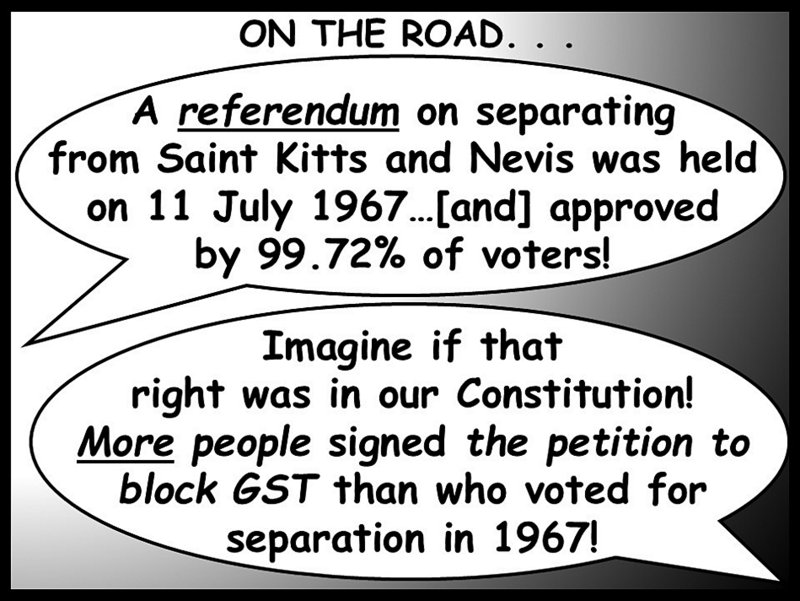
And yet. “A referendum on separating from Saint Kitts and Nevis was held in Anguilla on 11 July 1967…[and] approved by 99.72% of voters.”[6] Imagine if that right to initiate or repeal laws was in our Constitution. The People signed petitions to block the Goods and Services Tax Act of 2021. The last petition was signed by more people than those who approved separation in 1967![7] Instead, the last election was our proxy for a referendum to repeal a repugnant law. In keeping with our most fundamental moment in history, does this unelected review committee have the vision to enshrine our right for a real referendum to finish the job to restore our civil rights and freedom of commerce?
Repeal General Services Tax – and pass a balanced budget bill. Now.
This article reflects issues raised on July 5, 2021, at the House Select Committee on GST Public Hearing.
[1]https://www.caymaniantimes.ky/news/anguilla-mulls-constitutional-reform; [2]https://ballotpedia.org/ States_with_initiative_or_referendum; [3] https://ballotpedia.org/Article_III,_South_Dakota_Constitution;
[4] https://ballotpedia.org/Article_XXIII,_South_Dakota_Constitution; [5] Anguilla Constitution Order 1982; [6] https://en.wikipedia.org/wiki/1967_Anguillian_separation_referendum; [7] https://www.caymaniantimes. ky/news/petition-against-new-anguilla-tax.