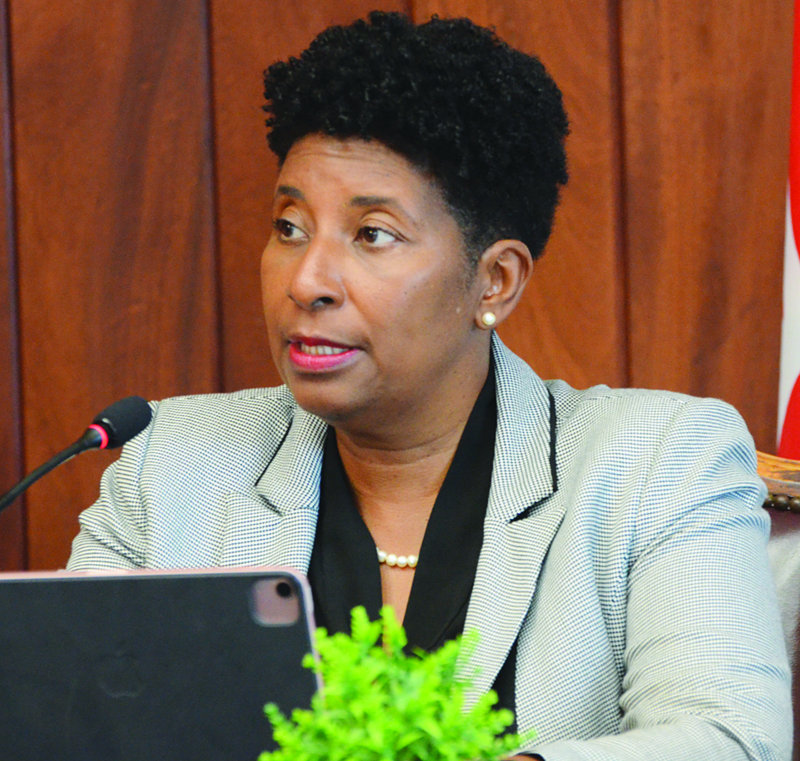
The Honourable Premier and Minister of Finance, Mrs. Cora Richardson-Hodge is continuing to articulate her concern over the impact the ongoing war in the Middle East can have on Anguilla.
The Premier was a guest on the Tuesday-night (March 31st) Government’s radio programme, “Just the Facts” hosted by the Hon. Minister of Education, Shellya Rogers-Webster. Also present on the programme was the Hon. Minister of Economic Affairs, Kyle Hodge.
For the most part, emphasis on the programme was placed on the ongoing war between Iran and the United States of America and Israel, and Premier Richardson-Hodge acknowledged the concerns that Government has with regard to the impact of the war on Anguilla.

“When the Iran war started, I had been paying particular attention,” the Premier said, “because I understand that a significant amount of the world’s oil comes from that area, with Iran being a major producer of oil. Therefore, I realized that the impact of the war in the region word eventually become apparent.”
She reflected on her becoming particularly concerned about the impact on the tourism sector, because at some point people could stop travelling to Anguilla. “They may want to stay closer to home,” she pointed out. “I also became concerned about further rises in the cost of living, as well as the volatility of the fuel prices, and how these would impact our people on a whole.”
“The volatility in fuel prices affects the cost of food,” she observed, “since in our country we import almost everything. When retailers import, the cost of shipping is added to the cost of their goods, and when those goods go on the shelves, that cost is usually passed on to the consumer.”
She also noted that the electricity company, ANGLEC, would be affected as well. “We could expect to see our electricity bills going higher if the cost of fuel is not managed.”
“We expect to see impacts from the war for as long as the war continues and even after it may end,” the Premier noted. “It therefore required Government to be proactive in finding ways to protect the people of Anguilla against severe impacts for however long we can, as long as the impacts of the war affect us.”
“What this means, she said, “is that Government has to absorb some part of these increased expenses, to a certain extent, because we are concerned about the most vulnerable in our society. We are concerned about homes and businesses, and so we have to look out for everyone all across the country and find ways in which we can preserve our standard of living for as long as we can.”
Minister Rogers-Webster commented that while Government seeks to alleviate the adverse impact on the people through absorbing portions of the cost of living, still Government must perform a balancing act in terms of providing the services that the people require.
“It is essential the Government makes decisions that are responsible,” she said. “While we ease the burden on the people of Anguilla, Government must, at the same time, protect its ability to function and operate in order to provide the essential services that the people expect.”
When asked to give a breakdown on the measures that have been taken to bring about this kind of people’s protection against the war’s impacts, the Premier listed three areas that Government has adjusted: 1 – Fuel at the pump; 2 – Maintaining electricity surcharge at the current rate of 42 cents per Kilowatt-hour; and 3 – Total removal of freight on imports.
All three measures will be implemented for a period of three months, and according to the Premier, pertinent extensions would be made if necessary, depending on how long the war and its effects would last. The Premier noted that in order to make these adjustments for the protection of the people, Government has had to absorb the potential increases which amount to approximately EC$6.5 Million over the three-month period.
The Hon. Minister of Economic Development, Kyle Hodge, who works in close coordination with the Premier and Minister of Finance, confirmed that these measures were carefully taken based upon the careful analysis of data which he, along with technocrats and Permanent Secretaries, collaboratively worked on together.
By James R. Harrigan