and Fitzroy Tomlinson
The conversations may have ended a week ago, but the resonance of the Anguilla Music Tourism Convention continues to hum across the island’s cultural landscape. Held from 5th – 6th November 2025 at Aurora Anguilla Resort, the gathering brought together international experts, regional artists, and local visionaries to explore how music and tourism can unite to fuel sustainable development.
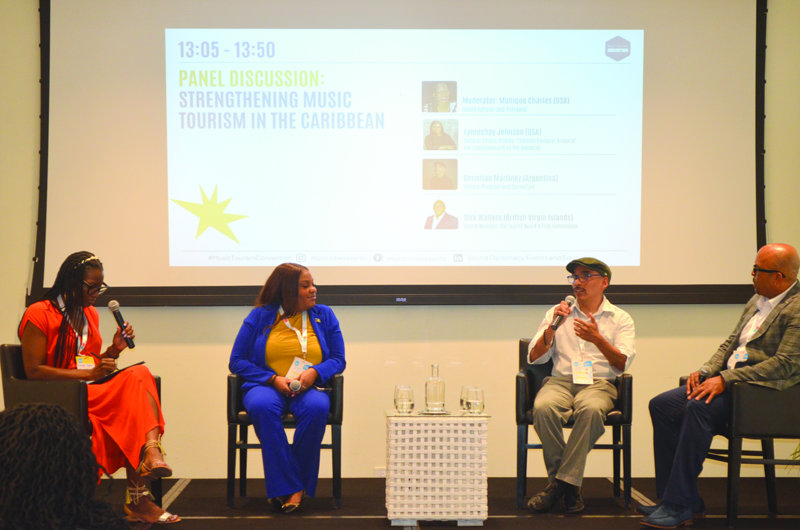
Day Two featured an engaging panel discussion titled “Bringing Local Music Genres into Tourism Strategies,” moderated by Dr Monique Charles of the United States. Panelists Lynreshay Johnson (The Bahamas), Christian Martinez (Argentina), and Dirk Walters (British Virgin Islands) explored how their homegrown sounds have evolved into cultural calling cards for visitors and how their musical traditions shape their tourism identity.
Panellists also discussed how policy and preparation can safeguard local creatives. Walters noted that the BVI once required event promoters to hire at least one local band whenever a foreign act performed — an idea that resonated strongly with the Anguillian audience. “If we don’t do that, we lose our identity,” he said pointedly.
Johnson added that the Bahamas’ newly designed cruise port allows “only Bahamian vendors,” ensuring that a visitor’s first encounter with the islands reflects its people and culture. In Argentina, Martinez called for government-backed initiatives that encourage the growth of new tango — a vision that could equally apply to Anguilla’s own efforts to modernise its traditional sounds without losing its soul.

Further presentations explored how creative infrastructure can transform communities. Greek producer Kostas Kalimeris’s case study of Blackrock Studios illustrated how recording destinations can boost local economies by attracting global artists year-round. “When international stars record here,” one slide noted, “their experiences become tourism promotion in themselves.”
Another presentation saw Andrew Lansley of the United Kingdom discuss how cultural events can foster sustainability. “Music and tourism bring people together,” he said, “creating connections that strengthen local economies and inspire travellers to explore more responsibly.”
Perhaps the most eagerly anticipated session was the local panel, “Why Professional Music Ecosystems Are the Foundation of Music Tourism in Anguilla,” moderated by Avon Carty. The discussion featured familiar names in Anguilla’s creative circuit — Fitzroy Tomlinson, Avenella Griffith, Crispin Brooks and musician Lois Hazell — who each examined how the island can build an ecosystem that nurtures both artistry and economic growth.
Tomlinson reflected on the island’s progress and challenges: “We don’t have to be fully developed to start. What we need is will and legislation that supports what we want to build.”
Hazell, a respected music educator, emphasised the importance of grounding young artists in their heritage. “We have to start with our history,” she said. “That’s how we ensure we have sustainable artists. We need music that can last forever — not just for the carnival season.”
Griffith agreed, envisioning string bands in every primary and secondary school: “They could play at assemblies, even in churches. That’s one way to maintain the culture.”
Creative entrepreneur Crispin Brooks provided a mini masterclass in turning artistry into industry. “The base of anything is the sound,” he said, walking participants through the essentials — from songwriting and branding to distribution and PR. “You have to sell not just your music, but yourself. Your image, your story, your identity.”
His advice resonated deeply when local artist Natalie Gumbs chimed in from the audience, calling for more investment in public relations. Brooks agreed, pointing out that every press run, every interview abroad, amplifies Anguilla’s name. “When you put it all together,” he said, “that artist becomes an ecosystem—because the lawyer, accountant, stylist, and community all benefit. It’s full circle.”
Still, the panel did not shy away from acknowledging obstacles. Limited infrastructure and accommodation continue to hinder large-scale festivals. “We can’t sustain big international events yet,” Tomlinson admitted. “But we have no problem collaborating—we just need to be realistic about scale and investment.”
Griffith added that differentiation is key to Anguilla’s global standing: “Our artists must let their Anguillianness shine. We have something unique here, and the world needs to feel it.”
Brooks suggested the island’s small size could actually be an advantage. Recalling innovations during the pandemic, he described how technology connected audiences virtually. “Stream our band clashes free for five years,” he proposed. “Let the world fall in love with Anguillian music first — then build from there.”
When asked about their vision for Anguilla’s place in the world, the panelists were unanimous: collaboration and consistency will drive the island forward. “It’s not about being the biggest,” said Tomlinson. “It’s about being authentic.”
As the curtains fell on the convention, Ministerial Assistant Jeison Bryan captured the mood with gratitude and determination. “This convention has shown us what is possible when the world comes together around the universal language of music,” he said. “Anguilla can stand tall among leading music destinations — not because we are the biggest, but because we are authentic, intimate and intentional.”
He pledged that the Ministry would continue to build on the ideas born during the event, strengthening infrastructure, creating opportunities, and ensuring that “culture is not only preserved, but also profitable.”
By Janissa Fleming