
Examination of the Anguilla Constitution Order of 1982 could not be complete without considering the work of Trevor T. W. Wan, a Harvard University Master of Laws candidate. In 2023, Wan published his research in the “Constitutionalization of Happiness: A Global and Comparative Inquiry.”[1]

Wan began with the most likely phrase that comes to mind from the US founders in 1776, he quoted how, “all equal men ‘are endowed by their Creator with certain unalienable rights, that among these are Life, Liberty and the pursuit of Happiness.’” He then added, “The Bhutanese Legal Code of 1729 likewise announced that ‘if the government cannot create happiness (dekidk) for its people, there is no purpose for the government to exist.’” Who could disagree?
Joy as Jurisprudence
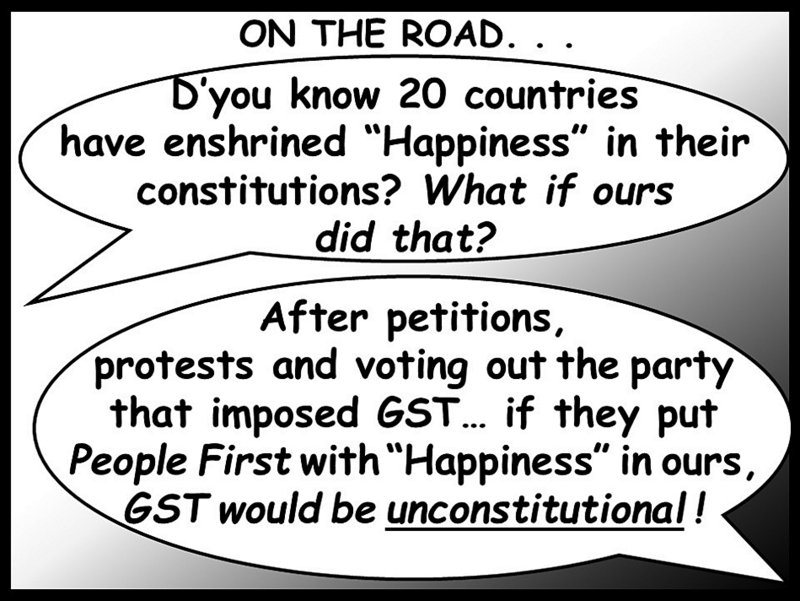
In fact, Wan’s study illuminated the inclusion of “happiness” in 20 constitutions and similar objectives like “well-being” in 110 of them by 2022. He described such cases as “the process of elevating happiness to the constitutional echelon, thereby bearing discernible legal and political implications.”
His earliest revelations were from the Polish-Lithuanian Commonwealth in 1791 and the French in 1793, where he quoted, “…‘The happiness of peoples depends upon just laws, the effect of the laws—upon their execution’” from the former, and “‘the aim of the society is general happiness (Le but de la société est le bonheur commun)’” from the latter. What about 1776? Wan noted that “pursuit of happiness” was in the US Declaration of Independence but not in the US Constitution when framed in 1789.
Nonetheless, he also cited how the pursuit of happiness has shaped US law with landmark cases in 1923 and 1967. They included the right to “‘engage in any of the common occupations of life, to acquire useful knowledge, to marry, establish a home and bring up children, to worship God according to the dictates of his own conscience, and generally to enjoy those privileges long recognized at common law as essential to the orderly pursuit of happiness by free men.’”
Constitutional Crossovers
Wan further observed how “constitutional ideas, designs and provisions” are replicated and adopted from one nation to another. He explained, “These mechanisms encompass the conscious copying of constitutional text and language, the imposition of constitutional arrangements from one state onto another, and the judicial borrowing of and citation to foreign constitutional ideas and jurisprudence.”
One glaring “imposition” of language occurred in 1947: “‘[a]ll of the people shall be respected as individuals. Their right to life, liberty, and the pursuit of happiness shall, to the extent that it does not interfere with the public welfare, be the supreme consideration in legislation and in other governmental affairs.’” Indeed, US General MacArthur led the drafting of the Japanese constitution following World War II. Was our Constitution “Order” also “imposed” on us, or perhaps consciously copied from others?
Gross National Happiness – Yes, really.
Located between China and India, Bhutan worked toward enshrining “Gross National Happiness” (GNH) in its constitution by 2008. Wan found, “‘… the pursuit of Gross National Happiness’ [and a requirement for] … the Royal Government to ‘protect and strengthen the sovereignty of the Kingdom, provide good governance, and ensure peace, security, well-being and happiness of the people.’”
The Bhutan constitution also provides a tangible framework for this concept. Such clauses include the commitment to “‘preserve, protect and promote’” cultural heritage, e.g., monuments, the arts, language, and religion. It also established protections for the “natural resources and environment” – including a specific share of land for conservation. Another pillar of Bhutanese “happiness” is underpinned by “‘ecologically balanced sustainable development while promoting justifiable economic and social development.’” And their civil rights were safeguarded as, “‘…a civil society free of oppression, discrimination and violence, based on the rule of law, protection of human rights and dignity, and to ensure the fundamental rights and freedoms of the people.’” As such, attention to culture, the environment, sound policies and civil rights guarantees combine to ensure “happiness” for the citizens of Bhutan, as they would for any dignified society.
GNH has been further enshrined in their laws. Yes, joy in jurisprudence! These have spanned wellbeing in the GNH, from tobacco control and health care access legislation, to water resources oversight in the context of “ ‘the age-old tradition of living in harmony with nature” among Wan’s examples.
Individual vs. Societal Freedoms
As the concept of happiness and freedom have permeated so many constitutions, Wan delved further into how the courts and parliaments have navigated the balance between personal and public “happiness” in law abiding societies while upholding morale as a primary covenant. Various cases have included debates over the most mundane yet potentially pernicious activities, from the risk of gambling addictions with unfettered youth access to online gaming, to seatbelt and alcoholic beverage laws, public access to private property, and freedom not to join a union, to name a few.
In South Korea, justices offered an overarching perspective, saying, “…The right to pursue happiness should be based on the protection of values shared among members of society and the rational constraint required to enable this. Any desires that are swayed by uncontrolled instinct, thus damaging the values pursued by the community…cannot be protected by the right to pursue happiness.”
In another case, the South Korean court further clarified, “The right to pursue happiness… does not indicate the right of citizens to actively demand benefits required to pursue happiness from the state, but the right to liberty in the broad sense that citizens are entitled to act freely without being intervened by state powers in pursuing their happiness.” Hmm. Like trying to make a living in a service business?
However, what matters most is that the elevation of “happiness” in any constitution places the morale and wellbeing of the People at the heart of the national discourse and as a standard for every law.
Progressive Promises that Put People First!
So, which countries have adopted constitutional “happiness” per se? Eswatini, Ghana, and Nigeria adopted “freedom and happiness” with references to livelihoods and social justice. Turkey established a duty to “ensure the welfare, peace, and happiness of the individual and society”; whereas the Thailand preamble seeks unity “to bring about happiness, prosperity and dignity to His Majesty’s subjects.” While Bhutan set a higher bar with the “pursuit of Gross National Happiness” and as South Korea protected “the right to pursue happiness” – Haiti, Japan, Namibia, and the Seychelles specifically adopted the “pursuit of happiness” text to enshrine a fundamental right for their people.
Petitions, a Protest, Votes at the Polls…and the General Services Tax (GST)
So. With more people signing a petition against GST in 2021 than who voted for separation in 1967, a full-fledged protest in the streets in 2022, and in 2025, electing a majority of ministers to replace ones who betrayed supporters by imposing GST, only a fool would think the People of Anguilla were “happy” with GST! And, the ugly outside child that replaced GST continues to prevent “happiness”: It still subjects our People to monthly risks of penalties, warrantless searches, errors risking assessments, seizures and months to resolve them – or get a pittance of interest in perpetuity, forced oaths without lawyers, and the insult of paying GST on ANGLEC, phone bills, concrete deliveries, even bespoke t-shirts, not to mention lawyers and accountants’ fees – still built into the prices of everything we buy and do. [2] It’s time to “consciously copy” those “happiness” constitutions! If they put People First with “happiness” in ours, GST would be unconstitutional.
Repeal General Services Tax – and pass a balanced budget bill. Now.
This article reflects issues raised on July 5, 2021, at the House Select Committee on GST Public Hearing.
[1] German Law Journal (2023), 24, pp. 1209–1236; doi:10.1017/glj.2023.84. [Open-Source; Cambridge University Press]; [2] General Services Tax Act, 2025. [To be continued…]