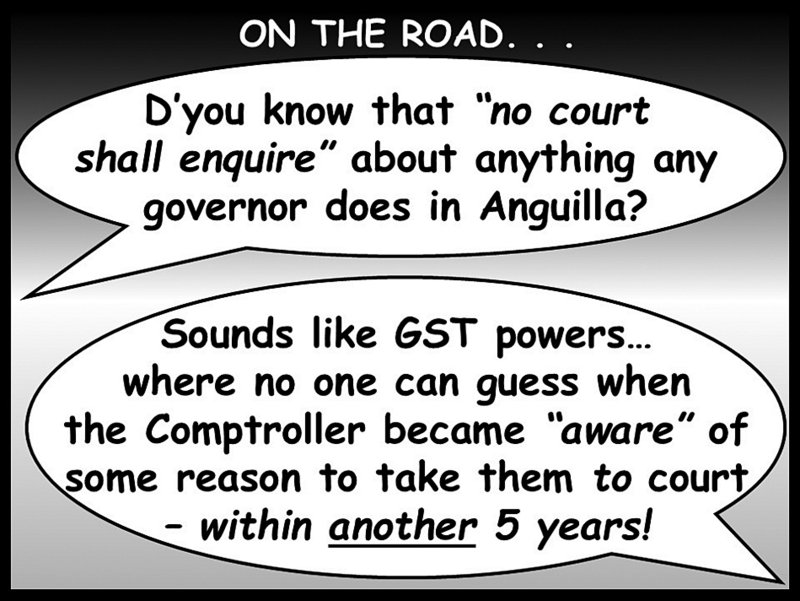

Continuing to consider our 1982 constitution – executive powers are conferred by Her (now, His) Majesty to the Governor, Acting Governor and Deputy, Executive Council and Secretary thereto, Chief Minister (now, Premier), and the Attorney General in Chapters II and III. [1] Most of us take most of these formalities and powers for granted and assume accountability for good governance to be among them. That said, some seemingly arbitrary powers merit our awareness instead of our assumptions.

Chapter II: The Governor – Serving at “Majesty’s Pleasure”
Section 19 begins with clarity, saying, “There shall be a Governor of Anguilla, who shall be appointed by Her Majesty and hold office during Her Majesty’s pleasure,” with powers “conferred or imposed on him by this Constitution or any other law and such other powers as Her Majesty may from time to time be pleased to assign to him…but no court shall enquire whether or not he has complied with any such Instructions.”[1] This appears to limit a Governor’s accountability to the monarch, alone.
Acting Governor
Section 20 addressed “any period when the office of Governor is vacant or the Governor is absent from Anguilla [> 48 hours], or is for any other reason unable to perform” whereby the monarch could designate an Acting Governor through the Secretary of State, or that, “the Attorney-General shall, during Her Majesty’s pleasure, act in the office of Governor” once they have taken appropriate oaths, and serve until notified of the Governor’s resumption of duties.[1] One recent example was Paul Candler’s role following Dileeni Daniel-Selvaratnam’s service and before the arrival of Julia Crouch in 2023.[2]
Governor’s deputy
Before Deputy Governors, Section 21 described how “the Governor…may in his discretion, by writing under his hand, appoint the Attorney-General…” or another “suitable person in Anguilla to be his deputy” to fulfill the duties as Governor until the monarch or the Governor revoke the role at their discretion; “…but no court shall enquire whether or not he has complied with any such instructions.”[1] Really?
Chapter III: The Executive
Section 22 echoes royal powers, but it allowed for delegation in Subsection 2: “Subject to the provisions of this Constitution, the executive authority of Anguilla may be exercised on behalf of Her Majesty by the Governor …but nothing in this subsection shall operate so as to prejudice the provisions of any laws … whereby functions are, or may be, conferred on persons or authorities other than the Governor.”[1] Well, except for Sections 27 and 28, to follow.
Section 23 established Executive Council to include the “Chief Minister [now, Premier], not more than three other Ministers and two ex-officio members” naming the AG and PS, Finance ? at that time. [1]
Appointment of Ministers – “Acting in His Discretion”
While the composition of a sitting government has been amended since 1982, it was interesting to see that, “The Governor, acting in his discretion, shall appoint as the Chief Minister the elected member of the Assembly who, in his judgment, is likely to command the support of a majority of the elected members of the Assembly”; and other Ministers would be appointed “in accordance with the advice of the Chief Minister…”[1]
What if, in “his discretion” the Governor wanted to appoint a Minister who was not the leader of the newly elected party? Or can the Governor appoint another Premier even if the incumbent party retained legislative majority? Why decide who is “likely” to be chosen by one’s peers – instead of allowing one’s peers to choose? And could anyone ask the court to debate who is “likely” to have the support of the elected members, since “no court shall enquire” regarding the Governor’s actions? Hmm.
Tenure of office of members
Section 25 enshrined that the Governor must “dissolve the Assembly” and set the date for a new election following a two-thirds “lack of confidence” vote in the Government. After an election [for that, or routine cycles?], the [Premier] “shall vacate his office” if the Governor tells him that he is “about to appoint another person as the Chief Minister.” Other reasons include: ceasing to be a member of the Assembly; not being elected; resignation; or if a court sentences him to “death or to imprisonment (by whatever name called) for a term exceeding twelve months.” [1] They thought of everything!
The Section goes on to state that other Ministers shall also be terminated by the Chief Minister [Premier] or the Governor with advice of the Chief Minister.[1]
Ministerial Duties – and Accountability without Authority?
Section 26 states that the Governor may “authorise any other Minister” to fulfill the [Premier’s] duties if unable to do so from illness or absence – and to revoke that authority “…in his discretion if, in his judgment, it is impracticable to obtain the Chief Minister’s advice owing to his illness or absence,” but otherwise with the [Premier’s] advice.[1]
Section 27 also starts off with the Governor and Premier in consultation to “assign to any Minister responsibility for the conduct (subject to the provisions of this Constitution and of any other law) of any business of the Government of Anguilla including responsibility for the administration of any department of government” – “Provided that a Minister shall not be charged with responsibility under this section for…matters mentioned in subsection (2)(a) and (b) of the next following section.”[1] …(a) “relates to defence, external affairs or internal security, including the police;” and (b)? Ministers are barred from:
28. (2)(b) “…the appointment (including the appointment on promotion or transfer, appointment on contract and appointment to act in an office) of any person to any public office, the suspension, termination of employment, dismissal, or retirement of any public officer or taking of disciplinary action in respect of such an officer, the application to any public officer of the terms or conditions of employment of the public service (including salary scales, allowances, leave, passages or pensions) for which financial provision has been made;”[1] So, is that why “any person in any public office” may not feel accountable to implementing policies for which the People elected Ministers?
…and GST? A Pattern of Discretionary Powers
Maybe the latter section helps explain gaps between the GST Relief implementation for one of the promised sectors failing to receive full relief. But those discretionary powers must have flowed straight from His Majesty through the Governor’s hand when she signed the General Services Tax Act. One public officer holds dominion over GST: from registration; to audits and records confiscation; remittance of overpayments and security deposits; assessments; seeking travel restrictions and court seizures for goods, capital and immovable property; replacement of damaged tax certificates – and more! We are also reminded that, “No criminal proceedings in respect of any offence under this Act shall be commenced except where the Comptroller determines to bring charges and prosecute…[and] where the offence alleged involves the failure to do any act as required under this Act, within 5 years after the Comptroller has become aware of such failure”! [3] Yes, powers so discretionary that they require mind-reading, with exposure to criminal prosecution – forever? Wow.
So. Will Anguilla set new standards for all democracies with this Constitutional review? And… will checks and balances be enshrined where “no court shall enquire” and where new laws oppress us today?
Repeal GST – and pass a balanced budget bill. Now.
This article reflects issues raised on July 5, 2021, at the House Select Committee on GST Public Hearing.
[1] The Anguilla Constitution Order 1982; [2] https://en.wikipedia.org/wiki/Paul_Candler; [3] General Services Act, 2025.