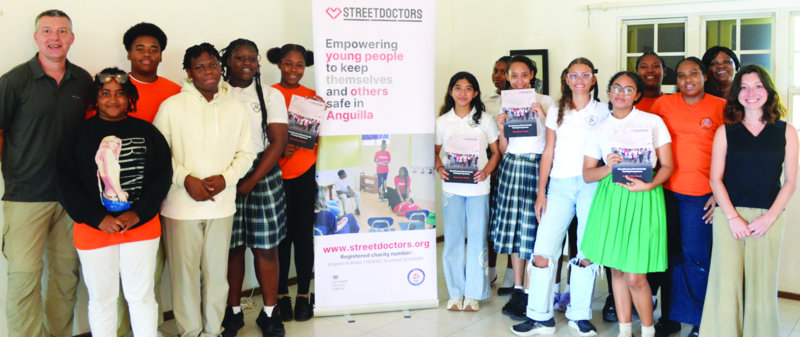
A group of young Anguillian leaders is stepping forward to support their peers following another round of training under the StreetDoctors Anguilla initiative – a programme aimed at strengthening youth awareness of mental health, violence prevention and community safety.
The Ministry of Social Development and Education, through its Community Services Planning Unit (CSPU), coordinated the latest phase of the initiative from Monday, 9th March to Wednesday, 11th March, 2026, continuing its work to empower young people to speak openly about mental wellbeing while equipping them with practical life-saving skills.
StreetDoctors Anguilla is a youth-led programme that prepares young leaders to deliver peer-to-peer guidance on issues affecting their generation, including emotional distress, conflict and injury. The initiative encourages responsible decision-making while promoting safety awareness and positive mental health practices among students and young people across the island.
The programme was first launched in October 2024 through collaboration between the Government of Anguilla and the UK Health Security Agency, with guidance from StreetDoctors Chief Executive Officer, Martin Tilbury. Since then, the initiative has steadily expanded. A second phase of training and recruitment in 2025 brought more young leaders into the programme while placing stronger emphasis on mental health awareness and violence prevention.
Drawing on discussions and experiences shared by the students themselves, participants previously developed a locally informed Mental Health Training Pack designed to support peer-to-peer conversations about emotional wellbeing, conflict resolution and the importance of seeking help.
Mr. Tilbury explained that the resource emerged after young people raised concerns about how mental health was being discussed within the wider conversation about violence.
“Last year we followed up from our initial work in Anguilla where we looked at street violence,” he said. “Young people in Anguilla looked at how they can train other people in the physical effects of violence. But one of the things the young people said to us was about how mental health was impacting them.”
He added that the feedback prompted a shift in focus. “We followed up the first visit with looking at a training programme to help young people explore how violence affects their mental health and how they wanted to understand what mental health meant. Based on that, the young people created a training pack which helps them to peer educate other young people about violence.”
The recent training sessions served both as a review and expansion of that work. Mr. Tilbury said the goal of the visit was to see how the youth-created materials were working in practice and to continue refining them with a new group of participants.
Thirteen students from the Albena Lake-Hodge Comprehensive School National Youth Empowerment Club, ranging from First to Fifth Form, participated in the training alongside five members of the National Youth Ambassadors Corps (NYAC). Also involved was Ms. Takiyah Richardson, Chief Executive Officer of Inside a Young Mind, who will support the continued rollout of the programme.
Several of the young participants were also bilingual, strengthening the programme’s ability to reach a wider group of students within the school community.
Throughout the sessions, facilitators focused on helping students understand mental health in ways that felt relatable rather than clinical.
“One of the things the young people told us in Anguilla was that when people talk about mental health it seems very clinical,” Mr. Tilbury said. “But when they described mental health, they talked about it being their wellbeing.”
To simplify the concept, trainers introduced practical and interactive exercises. One activity involved a shaken bottle of soda, used as a metaphor for emotional pressure.
“If you shake the bottle too much it becomes too tense,” Mr. Tilbury explained. “And if you keep putting lots of pressures onto it, it becomes too much. The process is about helping young people realise how stress builds up and then looking at ways they can relax themselves.”
The programme also incorporated practical emergency response training – at the students’ request. During a session held on Tuesday, 10th March, 2026, students received basic first-aid training led by facilitator Rachele Ferrario.
Participants were introduced to the body’s vital organs and how to respond if someone is seriously injured. They were taught how to control bleeding in emergencies, including injuries caused by stabbing or gunshot wounds, and the essential steps to take before assisting someone — such as ensuring the scene is safe, calling for help and applying pressure to wounds.
Students also learned how to perform cardiopulmonary resuscitation (CPR) on babies, children and adults, practising the techniques in hands-on demonstrations.
By the end of the training, the young participants were not just learners but facilitators themselves. Working in groups, they recreated what they had learned through interactive exercises designed to teach others about mental health awareness and first aid. Members of the NYAC also joined in the activities, supporting the collaborative and peer-led environment the programme aims to foster.
Mr. Tilbury said he was particularly encouraged by the impact Anguillian students have already had beyond the island.
“What we found from developing the pack is that other people, not only in Anguilla but also internationally, have learned from the young people here,” he said.
As a UK-based charity, StreetDoctors operates with limited resources, but Mr Tilbury expressed a strong commitment to continuing the partnership with Anguilla.
“We’re really happy to support wherever we can,” he said. “We’re also looking at developing volunteer teams and seeing how we can build a sustainable system so that the training continues to grow here.”
For the Community Services Planning Unit, initiatives such as StreetDoctors Anguilla, represent a broader commitment to placing young people at the centre of solutions to issues affecting their generation.
By equipping students with leadership opportunities, life-saving knowledge and the confidence to speak openly about mental health, the programme continues to build a network of youth advocates dedicated to strengthening safety, resilience and wellbeing throughout Anguilla’s communities.
By Janissa Fleming