Anguilla has taken a deliberate and strategic step towards strengthening its response to trauma, grief and violence, as eighty frontline professionals completed an intensive two-week certificate training programme aimed at transforming the way institutions and communities care for vulnerable people.
The initiative, spearheaded by the Ministry of Social Development and Education through its Community Services Planning Unit (CSPU) and the Department of Probation, concluded with a closing ceremony on Friday, 27th February 2026. The ceremony brought together participants, facilitators and senior officials to reflect on what organisers described as a timely and critical investment in Anguilla’s human services infrastructure.
As previously reported, Week One of the training – held from Monday, 16th February 2026 to Friday, 20th February 2026 – focused on Trauma-Informed Care for Residential Care Workers. Residential staff and frontline professionals responsible for supervising and supporting children, young people and adults within institutional settings were equipped with practical tools to better understand how trauma shapes behaviour, emotional regulation and decision-making.
Building on that foundation, Week Two, held from Monday, 23rd February 2026 to Friday, 27th February 2026, broadened the scope to Community Trauma, Grief and Violence-Reduction Training. This phase drew an even wider cross-section of stakeholders, including probation officers, social workers, counsellors, police officers, educators, health professionals, youth workers and other community responders.
Participants examined traumatic loss, grief counselling in crisis situations and community-based trauma response, while developing practical strategies to strengthen resilience among families and communities impacted by violence and loss.
The sessions were facilitated by Dr. Royette Williams-James, a Trinidad-based regional specialist with nearly two decades of experience in trauma and behavioural intervention, the sessions moved beyond theory.
Delivering remarks at the closing ceremony, P.S. Social Development Dr. Bonnie Richardson-Lake thanked participants for their commitment and urged them to translate learning into action. She highlighted a crucial shift in perspective championed throughout the training. “A trauma-informed approach challenges us to think of a different set of questions, not what is wrong with you, but rather what has happened to you and what can we do to help you feel safe and supported.”
Dr. Richardson-Lake also emphasised staff well-being, reminding participants that the work of caring for traumatised individuals carries its own emotional toll. “You cannot pour from an empty cup,” she said. “When you’re working with young people and families carrying deep pain, you’re also at risk of suffering that pain and compassion fatigue. The self-care plans, boundaries and resilience strategies you’ve explored are not just extras. They’re really essential.”
She cautioned against allowing the training to end with a certificate alone. “Training can’t just be us giving you a certificate. You really have to translate what you learn into practice.”
The impact of the sessions was evident in the testimonials that followed.
One participant from the Mental Health Institution within the Ministry of Health described the workshop as transformative. “Many of us suffer trauma in many ways. But one thing is that we swallow it like food. One thing we have to do in order to cure trauma is to speak out.”
Dr. Oluwakemi Linda Banks, Clinical Psychologist within the Ministry, said the training offered both professional refreshment and personal reflection. “It helped to refresh my memory of a lot of theories, but also give me another angle from which I can now look at things like trauma and grief,” she explained.
Retired professional Mrs. Anita Martin-Ruan described the course as one she was eager to attend from the outset. She praised Dr. James’ energy and authenticity, noting that grief and trauma are “real in Anguilla”. “After this week, I feel I am in a better place to help. I now know that I was doing the right things, how to improve on those things and how to implement other techniques.”
Mrs. Jennifer Gumbs, Senior Health Educator at the Health Authority of Anguilla, described the training as “the best workshop ever” and commended organisers for its timeliness. “Many times we hear in society, what is government doing?” she said. “But this workshop shows us as a community, we need now to take the information that we got in here and really serve our community.”
In her closing remarks, Dr. Williams-James expressed gratitude for the engagement she experienced over the two weeks and reiterated the importance of implementing the lessons learned in their professions.
She issued a sober warning as well. “You guys have the opportunity to arrest your issues and face them head on. …Let us use the information that we acquired for the betterment of this place.”
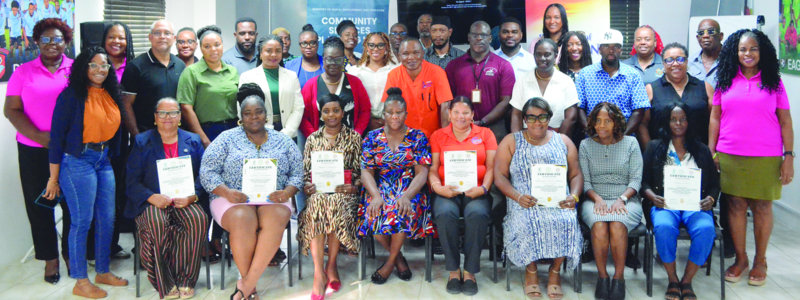
Certificates were presented to participants representing the Ministry of Social Development and Probation, Community Services Planning and Psychological Services, the Health Authority, Her Majesty’s Prison, the Department of Probation, Community Centres, the Royal Anguilla Police Force, the Red Cross, the Fire Department, teachers, counsellors, the Department of Sports and the Department of Education. Special recognition was also given to Ms. Christine Brooks for assisting in the absence of Permanent Secretary Dr. Richardson-Lake.
As Anguilla continues to navigate the complex social realities of trauma, loss and community violence, training is only the beginning. The real work now lies in classrooms, counselling rooms, prison corridors, police stations and homes across the island.