
Chapter IV of our 1982 Anguilla Constitution Order established the House of Assembly with respect to membership and structure in its initial sections. These are followed by a similar framework for the voters who elect our House members. Yet again, the Constitution presents the absurdity of keys left in the locks, whereby voting rules may be changed by any future laws. [1]

Qualification of voters
Section 43 enumerates qualifications to vote with respect to age [18; whereas the candidates must be at least 21], citizenship [Anguillian – or Commonwealth?], residency [Anguilla] and registration [voter initiated if qualified]:
“Subject to the next following subsection a person shall be qualified to be registered as a voter in an electoral district [and the single electoral district, 2019] if he is of the age of eighteen [18] years and upwards and—is [an Anguillian, 2019], and is domiciled there at the qualifying date; or…who has resided in Anguilla for a period of not less than twelve [12] months immediately before the qualifying date, and is domiciled there at that date, and is the lawful spouse, widow or widower, or the son or daughter or the spouse of such son or daughter of a person who was born in Anguilla; or is a Commonwealth citizen domiciled in Anguilla and has resided there for a period of at least five [5] years immediately before the qualifying date; and is at the qualifying date resident in the electoral district in which he claims to be registered [and]… entitled to be so registered provided that a person shall not be registered as a voter in more than one electoral district.”[1,2]
Disqualification of voters
Section 44 then echoes the disqualifying constraints for members of the House for voters, including:
“…[being] under sentence of death imposed on him by a court in any [country, 1990], or is under a sentence of imprisonment (by whatever name called) exceeding twelve months imposed on him by such a court or substituted by competent authority for some other sentence imposed on him by such a court [and if the offense would also be such in Anguilla, 1990]…[or] certified to be insane or otherwise adjudged to be of unsound mind under any law in force in Anguilla; or is disqualified for registration as a voter by any law in force in Anguilla relating to offences connected with elections.”[1,3]
Subsection 2 continues, “For the purposes of …the preceding subsection—two or more terms of imprisonment that are required to be served consecutively shall be regarded as a single term… for the aggregate period of those terms; and no account shall be taken of a sentence of imprisonment imposed as an alternative to, or in default of the payment of, a fine.” [1] This holds the voters to the same standards as the members.
Right to vote at elections
Section 45 ensures the right to vote, if registered in a geographic [and the single electoral, 2019] district… Well, “unless he is prohibited from so voting by any law in force in Anguilla—because he is a returning officer; or because he has been concerned in any offence connected with elections.” [1,2]
Further, “No person shall vote at any election for any electoral district who—is not registered as a voter in that district; has voted in another electoral district at the same election; is in lawful custody; or is for any other reason unable to attend to vote in person (except in so far as it may be provided by law that persons unable so to attend may vote).” [1] Hmm. Would some want to turn that key if such a future law could enfranchise those “unable to attend to vote in person” due to business, education or medical care – and the entire diaspora – by removing residency requirements to vote?
Laws as to elections
Speaking of which, Section 46 enumerates laws they envisioned in 1982, saying, “Subject to the provisions of this Constitution, the Legislature may provide for the election of members of the Assembly, including (without prejudice to the generality of the foregoing power) the following matters, that is to say— a) the qualifications and disqualifications of voters and candidates; b) the registration of voters; c) the ascertainment of the qualification of voters and of candidates for election; d) the division of Anguilla into electoral districts for the purpose of elections; e) the holding of elections;” Hmm. Sounds like residency qualifications could change with a single trip to the House and a single law!
But beyond laws regulating voting and elections processes, this Chapter also considered laws for, “f) the determination of any question whether any person has been validly elected a member … or whether the seat of any elected member… has become vacant; g) the definition and trial of offences connected with elections and the imposition of penalties therefor, including the disqualification for membership… or for registration as a voter or for voting at elections, of any person concerned in any such offence; h) and the disqualification for election as members… of persons holding or acting in any office the functions of which involve any responsibility for, or in connection with, the conduct of any election or the compilation or revision of any electoral register.” [… = “of the Assembly”; 1]
And in 2019, the amendment enshrined legislative powers to enact a single island-wide district, to determine how many single district members may be “returned” to the House, and empower voters to choose their own district leadership – as well as vote for as many seats as established from the island-wide slate.[2]
Residency Requirements, Policy Politics – and GST
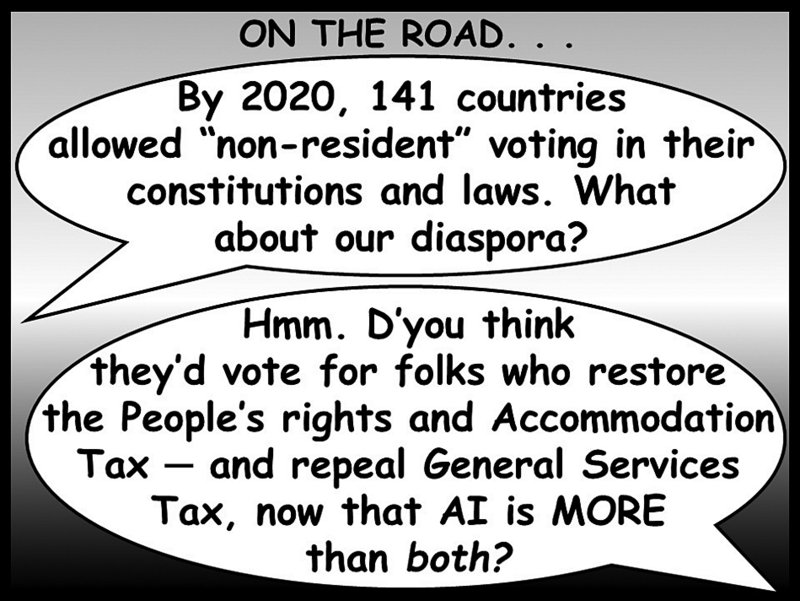
And back to the democratic debate about our diaspora and whether they should be welcomed home to vote, or if the Home of AI can offer a secure, virtual means to enfranchise those defined as “Anguillians” no matter where they reside. Notably, “As of 2020 a total of 141 countries grant non-residents such as emigrants or expatriates the right to non-resident citizen voting…[including] in person at diplomatic missions or other physical locations, by post or online…[for] the national legislature, executive elections, referendums, or sub-national elections.” [4]
Many may recall, however, that the election of 2020 was believed to effectively exclude the diaspora due to Covid closures, helping the party that ran against GST to win 7 of 11 seats without widespread whispers of hushed homecomings. Then again, in 2025, with the borders wide open, the party that ran against GST won 8 of 11 seats. Hmm. Old fables of family voting seem to have faded, because the electorate appears to have voted more on policy than progeny in recent years.
On this topic, the Constitution seems clear: That a single trip to the House to pass a new law could enfranchise all proudly proven Anguillians – without need for Constitutional review or revision. Likewise, we saw on July 29, 2025, that a culturally intrusive law that contravened prior Constitutional rights could be repealed with a single vote in the House.[5] So. Will we join other countries by officially enfranchising our People, including all Anguillians, through leading-edge tech, as our new moniker suggests? And… will the next election be won by those running against the continuing civil rights challenges of the General Services Tax (GST) – or by those who can say they repealed it?
Repeal General Services Tax – and pass a balanced budget bill. Now.
This article reflects issues raised on July 5, 2021, at the House Select Committee on GST Public Hearing.
[1] The Anguilla Constitution Order 1982; [2] The Anguilla Constitution (Amendment) Order 2019; [3] The Anguilla Constitution (Amendment) Order 1990; [4] https://en.wikipedia.org/wiki/Non-resident_citizen_voting; [5] General Services Act, 2025.