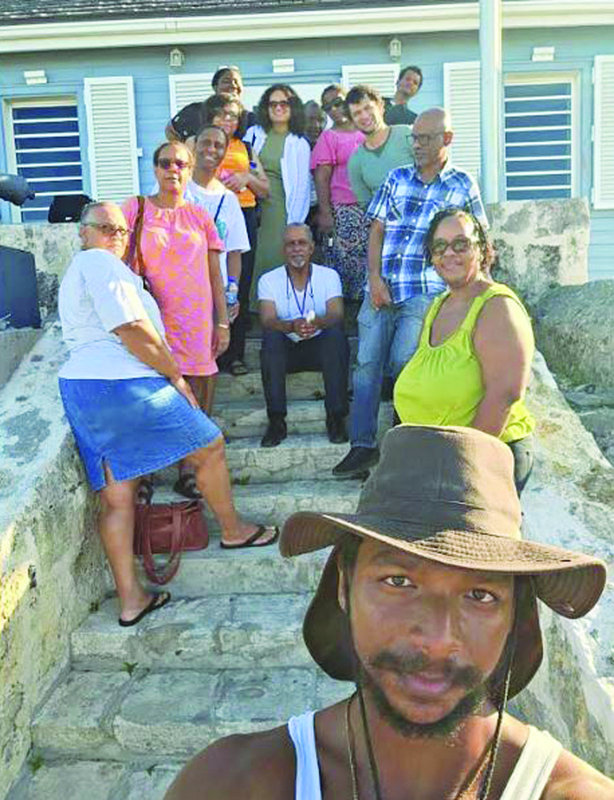
our guide, CJ.
They came to Anguilla for a funeral. Not the kind of trip anyone plans with excitement—flights to arrange, black clothing and sadness folded into suitcases, conversations heavy with memory. Grief brought our family together, but once we were here, we realized that though this moment was born of loss it was also an opportunity––an opportunity to ensure that younger generations feel connected to this place we call home.
Some were visiting for the first time. Others had been away for far too long. We wanted them to see Anguilla—not the postcard version, but the Anguilla that shaped us; the one that existed before paved roads and modern conveniences. To take us on this journey, we reached out to our cousin Carl Webster (CJ). CJ is young, but as we learned over the course of a few hours, he carries a deep knowledge of Anguilla’s history. He rattled off dates, names, and events with ease, pointing out ruins, former plantations, old wells, and forgotten spaces hidden beneath brush. What might have look like overgrown land to us, he described as living chapters of our island’s story.

Time was short, so we made the most of it. We stopped at the Miriam Gumbs Home to visit Daddie (Eldridge “Coo” Webster)—biological father to some of those visiting, but ‘Daddie’ to us all. Though CJ did not speak much there, history still found its way into the conversation. Coo shared stories of his days of sailing between the islands taking produce and bringing back supplies and other goods to Anguilla.
We visited the Old Courthouse which now holds the Heritage Museum Collection. While we were unable to experience a full tour of the facility, we stood in a space that became deeply personal to our family. One of our ancestors, Augustus “Chappy” Vanterpool, spent time in the lower level of the courthouse––as a prisoner. We shared stories and learned of Chappy’s adventures including his daring breaks from the prison on more than one occasion.
CJ explained how changes had been made to the building over the years. We saw where prisoners were once held. He described the physical constraints they endured; the thick walls––made from local limestone rock, the strategic layout, and separation of spaces––each telling their own story of a bygone era.
We lingered there longer than expected, imagining how our great-great-grandfather must have felt. He was tall, so we joked that perhaps he simply stepped through a window to make his escape. But beneath the laughter was something more complicated—a clearer understanding of the choices that led him there and the confines he existed in. In that moment Anguilla’s history was personal.
From there, we made a short visit to Wallblake House, walking the grounds and exploring nearby ruins. There is something about ruins that forces one’s imagination to fill in the blanks. We shared our thoughts on how workers may have moved among those spaces serving those who live at the house.
As the sun began to set, CJ took us to an area in South Hill––the Hughes Plantation. Not all of us ventured into the bush, but we were all struck by something else entirely—how much more mature CJ seemed in just those few short hours. His passion for the island’s past was unmistakable.
By the end of the day, something had shifted. We still admired the beaches and the hotels that draw visitors to our island. But we were reminded that Anguilla is more than sand, sea, and sun. It is more than stone foundations and overgrown fields. It is the preserved and unpreserved plantation houses. It is oral stories carried forward—by young people determined not to let them fade. It is home.
We were not able to visit every site CJ had planned, but what began as a week of sadness ended with us feeling more grounded. We left with a deeper understanding that while Anguilla continues to evolve, its history stands—not as a relic, but as foundation.
In next week’s issue, we will share CJ’s views on preserving and sharing Anguilla’s history.
By Kareen Rogers