In a small island nation where every number counts — from the number of tourists landing at Clayton J. Lloyd International Airport to the gallons of water flowing through our reservoirs — Anguilla’s Statistics Department has once again reminded us that data is far more than digits. It’s the pulse of our society.
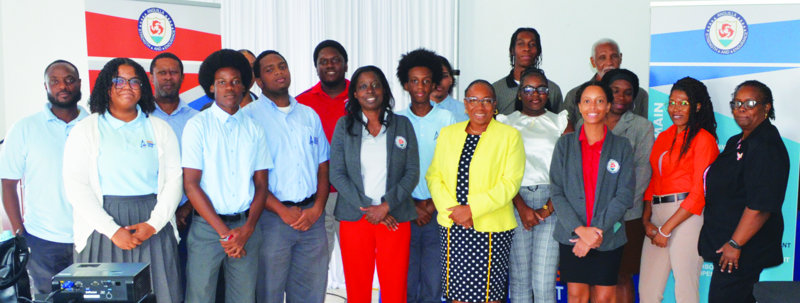
On Tuesday, 14th October 2025, the Department hosted its Journalists and Students Workshop as part of Statistics Week, which began on the 12th under the theme “Improving Lives Through Statistics: Strengthening and Innovating Together.” The event brought together sixth-form Communication Studies students, journalists from The Anguillian and Radio Anguilla, staff from the Anguilla Community College, and members of the Statistics Department — a full room of curious minds, eager to see how numbers tell the stories behind the headlines.
Opening the workshop was Mr. Larry Franklin, Permanent Secretary in the Ministry of Economic Development, Industry, Commerce, Lands, Planning, Water and Natural Resources, who delivered an address that could be described as both stirring and pragmatic. “Statistics are just not numbers,” he declared. “They are the stories of our people, our workers, our families, our businesses, and our communities. Each figure represents someone striving for a better life.”
It was a sentiment that resonated strongly throughout the day — a reminder that data collection is not a bureaucratic exercise but a civic partnership between citizens and the State. Mr. Franklin underscored that sound data underpins every major government decision, from capital investment projects and economic policy design to environmental management and education planning.
“For the first time,” he announced proudly, “according to the Medium-Term Economic and Fiscal Plan for 2026–2028, Anguilla is projected to be fully compliant with all three borrowing guidelines under the Fiscal Responsibility Act.” That progress, he emphasised, “is rooted in discipline, sound policy, and solid data provided by the Statistics Department.”
His remarks painted a picture of what a data-driven government could mean for the island — a society that is not only informed but empowered. “Every road improved, every reservoir strengthened, every development project approved,” he said, “it all begins with informed, data-driven decisions supported by accurate information that you, the general public, help the Statistics Department to collect.”
Following his address, Chief Statistician Mrs. Lori-Rae Alleyne-Franklin took the floor with a message directed squarely at her audience of journalists and students: “Quality data is power,” she said, her tone both practical and impassioned. “For journalists, credible data is the foundation of responsible reporting. It helps uncover the truth, challenge misinformation, and build stories that inform the public and influence policy. For students, quality data shapes critical thinking and strengthens academic work. In short, data isn’t just numbers — it’s a tool for storytelling, learning, and change.”
That theme of storytelling through statistics echoed throughout the day’s sessions. The first, Understanding and Interpreting Statistics, was led by Statistician Mr. Careme Carty, who guided participants through the language of data — from mean and median to standard deviation and margin of error. He reminded attendees that to communicate accurately, one must first understand the numbers themselves.
The second session, Spotting Bias and Misuse in Data, led by Mrs. Alleyne-Franklin, ignited lively debate among participants as they grappled with examples of correlation versus causation — a concept that even seasoned journalists sometimes misinterpret. One example of smoking and lung cancer sparked particularly animated discussion, driving home the point that evidence determines whether data suggests correlation or causation.
The final workshop session, Storytelling with Data for Social Good, delivered by Senior Statistical Officer Mrs. Natalie Lake, offered perhaps the most creative challenge of the day. Participants were split into groups and tasked with crafting narratives from raw data sets — turning statistics into stories the public could not only understand but feel. Mrs. Lake urged participants to “make data relatable,” transforming numbers into real-life human experiences that resonate with everyday Anguillians.
The workshop culminated in a panel discussion titled “Innovating Together – Media’s Role in a Data-Driven World.” Panellists included Mr. Ken Banks, former Permanent Secretary of Infrastructure; Dr. Jacqueline Peters-Richardson, Registrar at the Anguilla Community College; and Ms. Janissa Fleming, representing The Anguillian. The discussion explored how journalists, educators, and policymakers can work hand-in-hand to build public trust in statistics, combat misinformation, and strengthen collaboration across sectors.
If one message emerged clearly from the day, it was this: statistics are not the business of one department — they are everyone’s business. When businesses share data, when students learn to interpret it, and when journalists tell its stories responsibly, the entire nation benefits.
As Anguilla continues to strengthen its development frameworks and refine its national strategies, one thing is certain — the path to progress is paved not just with plans, but with proof. And that proof, as Mr. Franklin so aptly put it, begins with “accurate, transparent, and responsibly used information.”
By Janissa Fleming