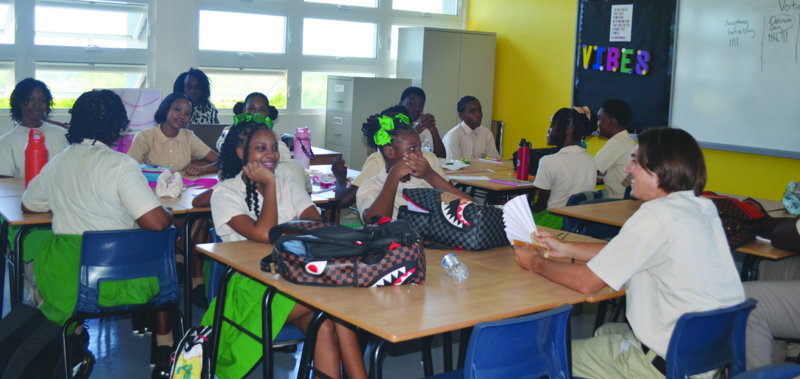
Schools across Anguilla reopened their doors throughout the week of September 1st 2025, with their usual mix of chatter, nerves, and fresh uniforms. At the Albena Lake-Hodge Comprehensive School (ALHCS) Campus Q, the day began with a brief but purposeful assembly before fourth and fifth formers were ushered into their form classes. New third formers, wide-eyed and adjusting to the bigger stage of secondary life, were given guided tours to help them find their way. One 3rd former expressed his nerves of being on a new campus, but also highlighted his excitement of taking art as a subject. Meanwhile, a fifth former somewhat jokingly expressed her happiness at the start of what is her final year at secondary school.
Principal Dr. Trevor Hodge, speaking with The Anguillian that morning, described the reopening as “a good start.”
 “There was a feeling of enthusiasm among students this morning as they entered and saw the little effort that was made to welcome them. The way we set the tone at the beginning is the tone that we set all year long,” he said.
The new academic year brings notable changes to the curriculum. One of the major changes this year is the shift to BTEC qualifications, an internationally recognised system that opens doors well beyond the Caribbean. Hospitality, for instance, will no longer be tied to a strictly American syllabus. At the Campus B, the timetable has also been lightened. Students now take nine subjects instead of thirteen, a move designed to ease both the academic and financial burden. English, science, mathematics, and social studies remain at the core, alongside physical education and personal and social health. Students rotate between French and Spanish in consecutive years, and then choose two electives ranging from music to art.
A book buy-back scheme has also been introduced, where parents can sell back textbooks and students can purchase them second-hand at lower cost — a small but welcome relief to families.
Perhaps the boldest announcement was the ban on mobile phones across all campuses, approved by the Board of Governors. Dr. Hodge admitted it was a tough call, but one he felt was long overdue.
“Phones have been a distraction for years,” Dr. Hodge admitted. “It disrupts teaching and beyond that, we’ve had instances of students filming others without consent and posting on social media — that’s a breach of privacy.”
The stakes became higher during examinations when two Anguillian students were among the 80 candidates across the region that failed CXC exams due to irregularities. In those students’ case, it was because of cell phones. “If we develop a culture of no phones in school, then that doesn’t become an issue,” he explained. Instead, students will use school-issued laptops, which are restricted to academic use and monitored to prevent distraction. As for the age-old excuse of needing to call home, the principal was blunt: “We all survived without phones. If a student needs to call their parents, the reception is there.”
The school opened with more than 90% of its teachers already in place. A few who are travelling in from overseas or completing studies are expected to be on island by early October.
The theme guiding this school year is written in bold across ALHCS noticeboards: “The Impossible is Possible Every Single Day”. Dr. Hodge explained: “It challenges students to come prepared, even if they doubt themselves. And it challenges teachers not to write off a child, but to work with them.”
Among the school’s priorities are raising CXC performance levels, strengthening discipline, addressing teacher turnover, and expanding experiential learning opportunities for students.
Security remains a concern. While classroom doors have been reinforced so they can now be bolted, windows remain vulnerable. To prepare for worst-case scenarios, the school will soon conduct practice procedures to ensure all students and staff are safe. “God forbid we were to have that situation again, but students and staff must know what to do and where to do it,” Dr. Hodge noted. On natural disasters, the school’s Google Classroom system remains active, ready to ensure lessons can continue online if a hurricane disrupts face-to-face learning.
Dr. Hodge was also clear that the school cannot succeed alone.
“It’s a triangular relationship — the school, the home, and the community. Parents should never hesitate to contact the school if they have a concern. We want to foster that collegial relationship, because the students we produce here will eventually go out and work for them.”
Running a school of over 1,200 students and more than 150 teachers is no simple job, and Dr. Hodge acknowledged the challenges and shortcomings. But he remains optimistic.
“The school is not a perfect institution, but we are constantly engaged in finding ways to improve the student experience and the output of the school,” he told The Anguillian.
And so, as balloons sagged in the heat and students snapped their first photos of the year in the decorative frames, the 2025–2026 school year officially got underway. From ALHCS to all primary schools, they have opened their doors once more, setting the stage for a year of learning, resilience, and growth.
By Janissa Fleming