
In our 1982 Anguilla Constitution Order – the House of Assembly is the workplace of our elected representatives to debate opportunities and challenges to address through policies and legislation. However, limitations set forth in preceding sections with respect to the Governor’s, Deputy Governor’s and Attorney Generals’ (AG) powers provide a context for concern. [1]

“There shall be a House of Assembly” – of Anguillians
Section 35 begins Chapter IV of the Constitution simply stating that Anguilla will have a House of Assembly, and that it shall “consist of – the Speaker” and “two ex-officio members, namely the Attorney General” and in 1990, the Deputy Governor replaced the PS Finance – and “not less than seven members elected in the manner provided by law”. There were two nominated members until 2019, when four elected “single district” seats were added.[1,2,3] Having the People choose them strengthened the democracy, but they kept two appointees accountable to the monarch, not the People. Baby steps.
House of Assembly Qualifications
Section 36 continues with qualifications, including voter registration in an electoral district, twenty-one years of age, and birth ? and residence ? in Anguilla “at the date of his nomination for election”; or living in Anguilla for at least 3 years before and on “the date of his nomination … and is the son or daughter [or grandchild, 2019], of parents at least one of whom was born in Anguilla.’[1,2] Whereas residency is under growing scrutiny for voters, but less so for parliamentarians.
House of Assembly Disqualifications
Section 37 counters, saying, “No person shall be qualified to be nominated or elected as a member of the Assembly who— holds or is acting in any office of emolument in the service of the Crown” [exclusive of “his services as such a member” – and for temporary appointees, see Section 40] …or who is “adjudged or otherwise declared bankrupt… certified to be insane or otherwise adjudged to be of unsound mind… under sentence of death imposed on him by a court in any [country, 2019] or is under a sentence of imprisonment… exceeding twelve months [for an offense also recognised under Anguillian law, 2019]…or is disqualified for membership of the Assembly by any law… relating to offences connected with elections.”[1,2] That’s reassuring, except that any future law can amend the constitution.
The Section then details how “two or more terms of imprisonment” can be treated as one, but they would not be disqualifying if imposed as an alternative to a fine. Would Mandela have been qualified?
Tenure of office of members of Assembly
Section 38 then describes how a “nominated or elected” member’s seat becomes “vacant” to define the term of office – “upon a dissolution of the Assembly…if, without prior notice to the Governor, he is absent from three consecutive meetings… ceases to be [an Anguillian, 2019]… to be resident … resigns his seat by writing … to the Governor…” or if any of the preceding – or following – reasons should apply. [1,2]
Section 39 stipulates that being sentenced to death – or imprisonment for over 12 months – would vacate the member’s seat “thirty days thereafter” but that the Speaker could add 30-day increments for up to 330 days, if requested for appeals. However, the period could extend further if approved by “the Assembly signified by resolution.” [1] Well, if not put to death by then.
That said, Clause 2 states that “a free pardon or [if] his conviction is set aside or his sentence is reduced to a term of imprisonment of less than twelve months or a punishment other than imprisonment is substituted, his seat in the Assembly shall not become vacant…and he may again perform his functions.”[1] While a convicted member seems undesirable, these allowances pay deference to the will of the People and the risk of unjust laws, well, assuming the member kept his or her election promises.
Appointed members of Assembly
Section 40 states that an appointed member’s absence due to “illness… absence from Anguilla or for any other reason incapable of performing” … “the Governor acting in his discretion may, by… public seal, appoint any public officer to be temporarily a member of the Assembly” at the monarch’s “pleasure” and shall vacate his seat when “informed by the Governor” that the appointee can resume his duties. Nonetheless, it requires that “any public officer” be held to the same standards as the ex-officio member,[1] despite the contradiction regarding emoluments in Section 37.
In 1990, an amendment also empowered the Governor to appoint the leader of the opposition if, in the Governor’s judgement, he represents an opposition party with the greatest “numerical strength” in the House, or “best able to command the support of the [opposition] members.”[3] So, the Governor can anoint the Opposition and appoint two House members accountable to the Crown, but not the People.
Determination of questions as to membership of Assembly
Section 41 anticipated challenges to membership. The validity of being appointed or vacating a seat as “a temporary member of the Assembly…shall be determined by the Governor acting in his discretion.” [1,2] Whereas questions of elected membership or vacated seats “shall be determined by the High Court, whose decision shall be final and not subject to any appeal.” While few individuals have the resources to appeal to the High Court, Section 41 gives the right to challenge an elected member to “a person who voted or had the right to vote at the election…a person claiming to have had the right to be returned at such election… alleging himself to have been a candidate at such election; or the Attorney-General.” [1] However, only an elected member of the Assembly or the AG can apply to the High Court to question if an elected member has vacated his seat.
But this section reserves one more power to the AG, saying, “If any application referred to in …this subsection is made by a person other than the Attorney-General, the Attorney-General may intervene and may then appear or be represented in the proceedings.” [1] Appointed by the Crown, could the AG also terminate such challenges, no matter the concerns of an elected member?
Penalty for sitting or voting in Assembly when un-qualified
Section 42 puts a bow on member decorum, saying, “Any person who sits or votes in the Assembly knowing or having reasonable grounds for knowing that he is not entitled to do so shall be liable to a penalty not exceeding EC$100.00 for each day upon which he sits or votes” and that the fine may be collected by civil action in the High Court or a suit by the AG. [1] Ah, if only.
Appointed members over-riding elected members’ votes
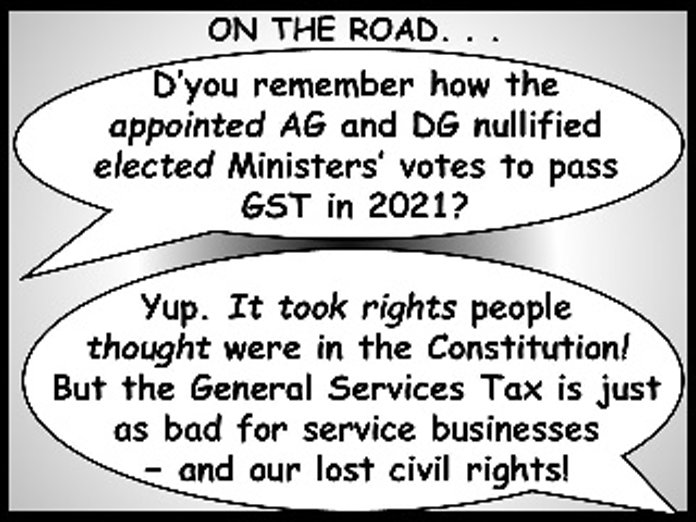
Ultimately, these House of Assembly sections expose the gulf between the law and recent customs of ex-officio members. That is, to refrain from voting on contentious matters that could have far-reaching impact on a society or the financial framework of the territory. And for the AG to recuse himself when giving legal advice to members of parliament. Had such customs been followed in 2021, GST would not have passed – and the current Government would not have had to compromise by passing the General Services Tax Act in 2025, which reimposed lost rights and fiscal fetters on our People and businesses when they, in fact, repealed GST.[4] A better way? The House of Assembly members “shall be elected in the manner prescribed by any law in force in Bermuda.” [5] Elected. Not appointees with voting rights.
So. Will Anguilla consider best practices for internal self-governance, with guardrails on appointees and the Governor’s discretion? And… will checks and balances be enshrined to prevent – or to fast-track the repeal – of newly oppressive laws put forth by appointees unaccountable to the People?
Repeal General Services Tax – and pass a balanced budget bill. Now.
This article reflects issues raised on July 5, 2021, at the House Select Committee on GST Public Hearing.
[1] The Anguilla Constitution Order 1982; [2] The Anguilla Constitution (Amendment) Order 2019; [3] The Anguilla Constitution (Amendment) Order 1990; [4] General Services Act, 2025; [5] Bermuda Constitutional Order 1968; Section 28 amended by UK SI 456/2003.