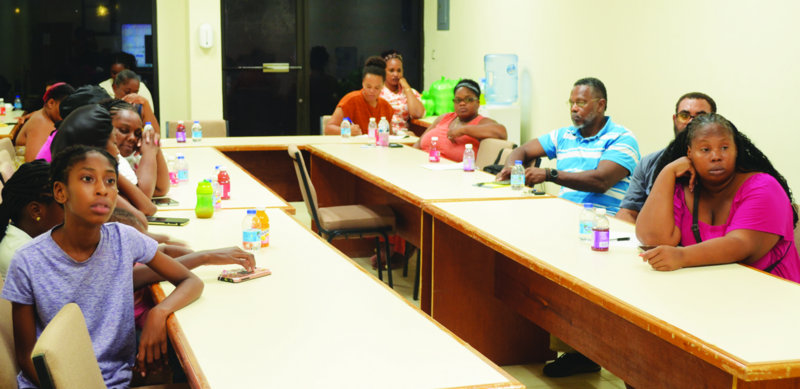
If you’ve been keeping an eye on the news lately, you’ll know that the topic of gangs and youth violence is not just “out there” in some big city—it’s a concern that creeps closer to home than many of us would like to admit. On Monday, 18th August, parents, guardians and concerned community members gathered at the Department of Youth and Culture training room for a workshop that tackled this very issue head-on. The session, titled “Gangs, Guns, and Our Youth: What Every Parent Needs to Know,” was delivered by Family First, the national parenting enrichment programme spearheaded by the Government of Anguilla through the Community Services Planning Unit.

This particular session featured Trinidad and Tobago-based Clinical Social Worker, Nasudah Muhammad, M.Sc., who joined virtually via Zoom. While parents from across the region logged on from afar, Anguillians turned up in person to listen, learn and ask questions. The Hon. Elected Member for Road North Merrick Richardson also attended.
Before the lecture kicked off, Senior Social Worker for Supporting Families, Denise Samuel, reminded attendees that parenting doesn’t come with a manual—and no one gets it perfect.
“I work closely along with the Community Services Planning Unit, Mrs. Hyacinth Bradley and the team, where we put together sessions like this for parents, supporters of vulnerable parents, supporters of our guardians,” she explained. “Whether you’re a parent in your 60s or 70s or 20s, there’s something that you learn.”
She encouraged commitment from those present and teased what’s next on the calendar—a vision board exercise this Saturday, 23rd August 2025, to help parents set family goals for themselves and their kids ahead of the new school year.
Meanwhile, Muhammad, during the session, didn’t shy away from the hard truths. According to her, the reasons why young people are pulled into gangs are as complex as they are troubling: the search for respect, belonging, protection, money, or simply excitement. For some, it’s peer pressure; for others, it’s the absence of supervision or a stable home life. Add to that family histories of offending, exposure to violence, or poor engagement in school, and the risk factors stack up quickly.
She outlined the different types of gangs—street gangs, prison gangs, hybrid gangs, drug gangs, youth gangs—and the hierarchies that make them tick. Guns, she noted, often become synonymous with gang life, used to intimidate, protect, and exert power.
One of the most useful parts of the workshop was the list of warning signs that parents can watch out for. A child suddenly withdrawing from family, slipping grades, defiance, secrecy, staying out late without reason, or even worrying excessively about safety could all be red flags.
But Muhammad was quick to reassure parents that not every hoodie or “street style” look means gang activity. “A child who dresses a certain way or acts a certain way doesn’t always mean they are in a gang,” she said. The true distinction, she stressed, comes down to behaviour. “What sets the real gang members apart from the ones who are simply expressing their personal style is crime.”
The conversation also delved into mental health, with Muhammad outlining “Conduct Disorder,” a condition that can show up in children and teens who consistently act aggressively and without empathy. Symptoms include everything from harming animals and people to property destruction, deceit and rule violations.
And then there’s the matter of identity. Teenagers are in the thick of figuring out who they are. If they’re given room to explore values, friendships and goals—with guidance—they’re more likely to form strong, healthy identities. If not, they may end up confused, vulnerable, and searching for belonging in all the wrong places.
So What Can Parents Do? Plenty. From building strong family bonds and keeping open lines of communication, to knowing your child’s friends (and their parents), monitoring online activity, and helping them learn how to handle peer pressure—parents still hold the keys. Discipline, consistency and simply being present in their children’s lives were all emphasised.
The take-home message? Children don’t just need rules; they need role models. And they need space to talk, experiment, fail, and try again—with adults who are paying attention.
Family First has much more in store, with two sessions every month—one virtual and one face-to-face—geared primarily at parents but with plans to expand to include children, expectant parents, and even Spanish-language workshops. As Ms. Samuel put it: “When you have a vision, what you see before you is different than just thinking in your head.”
And perhaps that is the essence of the initiative: to shift the way parents see not only their children, but their role in guiding them through a world that can be, at times, unforgiving.
By Janissa Fleming