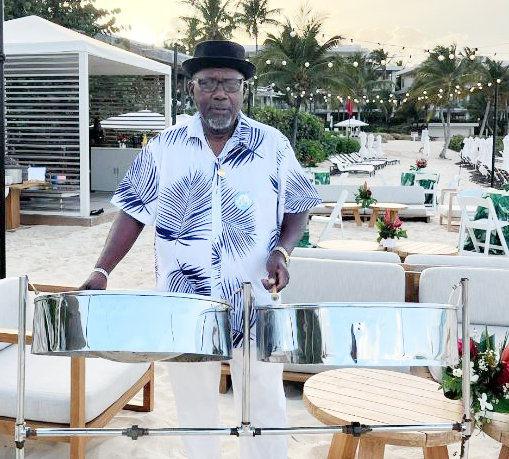
On 11 August 2025, we celebrated World Steelpan Day, a tribute to an instrument whose metallic hum carries the heartbeat of the Caribbean. The steelpan — light, joyful, and resonant — emerged from the spirited ingenuity of Trinidad and Tobago, and its melody has since soared across the globe, eventually finding a warm home right here in Anguilla.

It all began in the 1930s, in the hills of Laventille, Trinidad. There, creative communities turned adversity into music, crafting percussion from discarded oil drums, biscuit tins, paint pots, and spoons, after colonial authorities banned traditional drumming during carnival celebrations. The earliest “pans” evolved from the Tamboo Bamboo ensembles — bamboo percussion groups — which themselves were a response to those bans.
Innovation blossomed. Winston “Spree” Simon invented the “ping-pong” pan, a small hand-held drum capable of eight notes, laying the groundwork for modern steelpan. Then Ellie Mannette, often called the “father of the modern steel drum,” revolutionised pan-making by sinking 55-gallon oil drums into concave shapes, greatly expanding their tonal range and consistency.
In 1951, the world took notice when the Trinidad All-Steel Percussion Orchestra (TASPO) performed at the Festival of Britain — marking steelpan’s first appearance on the international stage. From there, steelpan’s percussive poetry spread to the United Kingdom, the United States, Canada, Europe, even Japan and Australia, carried by Caribbean migrants and curious musical souls alike.
By the early 1960s, steelbands were contesting in Panorama, the now-iconic competition in Trinidad held during Carnival — a musical replacement for rival street gangs, settled by rhythm rather than fists and weapons. Over time, the steelpan became both a national emblem — officially recognised in Trinidad & Tobago — and a global ambassador of Caribbean identity and resilience.
Here in Anguilla, steelpan has interwoven itself into school corridors, festival plazas, and our island’s joyous gatherings. Conversations with two local stalwarts —Michael “Dumpa” Martin and Casey Richardson — reveal the deep, personal, and communal threads of this instrument in our cultural tapestry.
Antigua-born, Michael “Dumpa” Martin remembers: “1972… that’s when I took part in Panorama. I was 17 years old.” It was his introduction to pan, joining a young band in Trinidad, which ignited his lifelong devotion. He laughs now at how a musical discipline “makes you a better person. It can change your life.”
Arriving in Anguilla in 1985, Mr. Martin performed regularly at Johnno’s beach spot. He was struck by the absence of steelpan in Anguillian schools and asked himself, “What’s going to happen to the music?” By 1992, he began teaching at the Albena Lake-Hodge Comprehensive School, and also at the primary schools in 1994 – nurturing students for 29 years until he retired four years ago. He sees steelpan as more than music — it’s teamwork, a cultural sanctuary in times of violence: “It is a unity instrument… a great help to distract children from trouble. They should join a steel-pan programme… get involved in something culturally.” And his pride shines in recollecting performances abroad — Philadelphia, Hartree College workshops, even St Martin’s Day — “They were great moments that brought Anguillans and everybody together.”
His message to youth? “If you don’t quit, you’ll make it. Just hang in there. Stay with it.”
Casey Richardson’s path was more unanticipated — he recounts that he “wasn’t initially drawn to it… until I actually played the pan.” At just nine years old, that spark set him on course to become, at 25, a government-employed Music Educator teaching steelpan in Anguilla’s public schools.
He noted the steel pan’s appeal, “It’s just so unique. I’ve been exposed to several other instruments but there’s something about the ring of the pan that appeals differently.”
Casey reflects that Caribbean peoples “take pride in steel pan and embrace it as ours.” That embrace, he believes, is alive but needs stronger roots locally. He notes a “ceiling” over steelpan here — progress is visible, but the art form “exists in a bubble.”
Yet Casey’s optimism is clear: he organised a summer camp from 14 July to 8 August 2025, culminating in a local steelband, under the name, Fusion Beat Steel Band, that performed in this year’s Grand Parade of Troupes. “Seeing the instrument truly embraced by my students and the onlookers was heart-warming.”
Steelpan’s story is one of transformation — from colonial repression to cultural pride, from street performance to orchestral display. Its journey mirrors ours: vibrant, rhythmic, resilient. In Anguilla, it brings out our best in festivals, classrooms, and public spaces, softly reminding us of our Caribbean kinship.
Our island may be small, but our ears and hearts are wide: the steelpan blends into our breeze, adding a shimmer to beach gatherings, an upbeat pulse to national events, and a gentle echo in school halls. If we nurture this instrument — through schools, support, and community — it will continue to uplift and unite.
So, as we reflect on World Steelpan Day, let us celebrate not only its Trinidadian birth, but its Anguillian heartbeat too.